In Brief
- ISO 9001 is being revised for the first time since 2015. Publication is expected in September 2026.
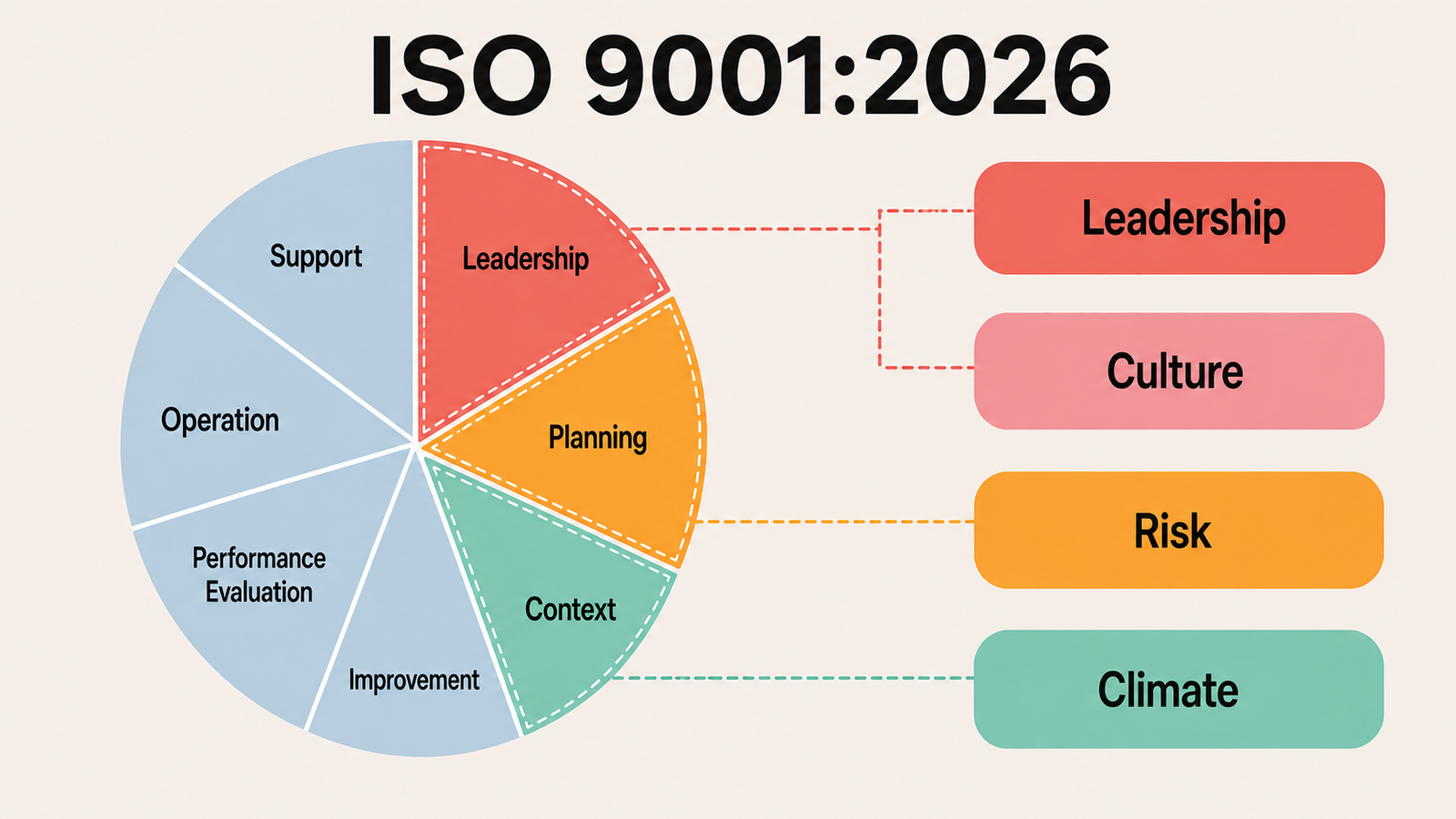
- The revision is being described by standards bodies as evolutionary rather than revolutionary. The new standard leans harder into leadership accountability, organisational culture, ethical behaviour, and risk and opportunity management, alongside a formal nod to climate considerations.
- For Singapore’s manufacturers and SMEs, the update is a reminder that certification bodies, customers, and auditors are increasingly judging quality as something an organisation does, not something a department checks.
For more than a decade, ISO 9001 has barely moved. The 2015 edition introduced risk-based thinking and folded the standard into ISO’s common high-level structure, and since then, it has been the quiet, dependable backbone of quality management systems worldwide — audited, certified, occasionally grumbled about, rarely questioned. That decade of stability is now ending. ISO’s own committee has confirmed that the working group behind the standard, TC 176/SC 2, reached full technical consensus on the core requirements after a key meeting in Mexico City in February 2026, and publication of ISO 9001:2026 is still on track for September 2026, with organisations already certified expected to get a multi-year window to transition.
On the surface, this sounds like routine standards housekeeping. Committees review, drafts circulate, edits get made. But the substance of what’s changing says something more interesting about how the idea of “quality” itself has shifted since 1987, when the ISO 900X series first appeared. Even the companion vocabulary standard has been rewritten for the occasion — ISO 9000:2026, published in May 2026, updates the field’s core definitions and terminology specifically to align with the incoming ISO 9001 and “reflect current business practices, technology, and stakeholder needs.”
From inspection to intention
ISO 9001 was born in an era when quality meant conformity — did the product match the specification, and could you prove it on paper. That’s quality control in its purest form: a checkpoint at the end of the line, a department with a stamp, a system built to catch defects before they reached the customer.
The 2026 draft doesn’t discard that foundation, but it clearly stops treating it as the whole story. According to certification body summaries of the approved draft, the revision strengthens requirements around leadership commitment to quality culture and ethical behaviour, expands how organisations must handle risk and opportunity rather than risk alone, and introduces a formal amendment addressing climate change considerations within an organisation’s context analysis. Quality advisory firm DQS frames the same shift in terms of what’s driving it: a stronger reference to sustainability, digitalisation, and changing stakeholder expectations running through the whole revision, rather than any single new clause.
None of these are things a quality control inspector can sign off on. They live upstream — in how leadership makes decisions, how a company treats the people who notice something is wrong, and how far a business is willing to look into its own supply chain and environmental footprint before calling something “quality.”
The most significant conceptual addition in the 2026 revision goes beyond existing leadership commitment requirements — top management must now explicitly demonstrate a quality culture and ethical behaviour throughout the organisation, not just sign off on a policy.
Why the shift now
It’s tempting to read this as ISO chasing trends — ESG, AI, resilience, the usual list. But the pressure has been building from a fairly specific direction. The pandemic exposed how fragile “quality” promises become when supply chains break. Digitalisation and AI have quietly moved decision-making — and error — further from any single inspection point. And customers, regulators, and investors have all started asking questions that a conformity certificate was never designed to answer: was this made responsibly, and can you prove the culture behind it is sound, not just the paperwork?
One certification body summary puts it plainly: the revision moves ISO 9001 beyond a compliance-driven framework, positioning it instead as a strategic tool for resilience, efficiency, and reputation. That’s a meaningful repositioning for a standard that, for many companies, has functioned mainly as a tender requirement or customer checkbox. Notably, ISO itself has described the revision’s aim as keeping the standard relevant rather than changing it just because it’s ten years old — input has been drawn from user surveys, interpretation requests, and lessons learned from a decade of applying the 2015 edition.
What this means if you're not chasing a certificate
For Singapore’s SMEs and manufacturers, ISO 9001:2026 doesn’t demand an immediate response — the transition window is long, and certification bodies themselves will need roughly 9 to 12 months after publication before they can even begin auditing against the new version. But the direction of travel is worth sitting with regardless of certification status.
Quality culture can't be delegated to a QA manager any more than trust can be delegated to a compliance officer. If leadership isn't visibly living it, an auditor checking a box won't manufacture it after the fact.
If a defect ships, if a supplier cuts a corner, if an employee spots a problem and says nothing — none of that shows up on a quality control checklist until it’s too late. That’s the gap this revision is trying to close: not by adding more inspection, but by asking organisations to be honest about the conditions that produce good or bad outcomes long before anything reaches a checkpoint.
That reframing — quality as a leadership and culture question rather than a QA function — is the thread running through the rest of this series. Next up: a plain-language breakdown of exactly what’s changed between the 2015 and 2026 editions, and which of those changes actually matter for how you run your business.