ISO 9001:2026 Is Set To Broaden The Quality Horizon. Leadership, culture, risk, and climate gain greater emphasis.

|

Article audio is generated by AI tool.

ISO 9001 2026
AI-assisted image: Created using a human-written editorial prompt. Click image to see AI prompt.

In Brief

  • ISO 9001 is being revised for the first time since 2015. Publication is expected in September 2026.
  • The revision is being described by standards bodies as evolutionary rather than revolutionary. The new standard leans harder into leadership accountability, organisational culture, ethical behaviour, and risk and opportunity management, alongside a formal nod to climate considerations.
  • For Singapore’s manufacturers and SMEs, the update is a reminder that certification bodies, customers, and auditors are increasingly judging quality as something an organisation does, not something a department checks.

For more than a decade, ISO 9001 has barely moved. The 2015 edition introduced risk-based thinking and folded the standard into ISO’s common high-level structure, and since then, it has been the quiet, dependable backbone of quality management systems worldwide — audited, certified, occasionally grumbled about, rarely questioned. That decade of stability is now ending. ISO’s own committee has confirmed that the working group behind the standard, TC 176/SC 2, reached full technical consensus on the core requirements after a key meeting in Mexico City in February 2026, and publication of ISO 9001:2026 is still on track for September 2026, with organisations already certified expected to get a multi-year window to transition.

On the surface, this sounds like routine standards housekeeping. Committees review, drafts circulate, edits get made. But the substance of what’s changing says something more interesting about how the idea of “quality” itself has shifted since 1987, when the ISO 900X series first appeared. Even the companion vocabulary standard has been rewritten for the occasion — ISO 9000:2026, published in May 2026, updates the field’s core definitions and terminology specifically to align with the incoming ISO 9001 and “reflect current business practices, technology, and stakeholder needs.”

From inspection to intention

ISO 9001 was born in an era when quality meant conformity — did the product match the specification, and could you prove it on paper. That’s quality control in its purest form: a checkpoint at the end of the line, a department with a stamp, a system built to catch defects before they reached the customer.

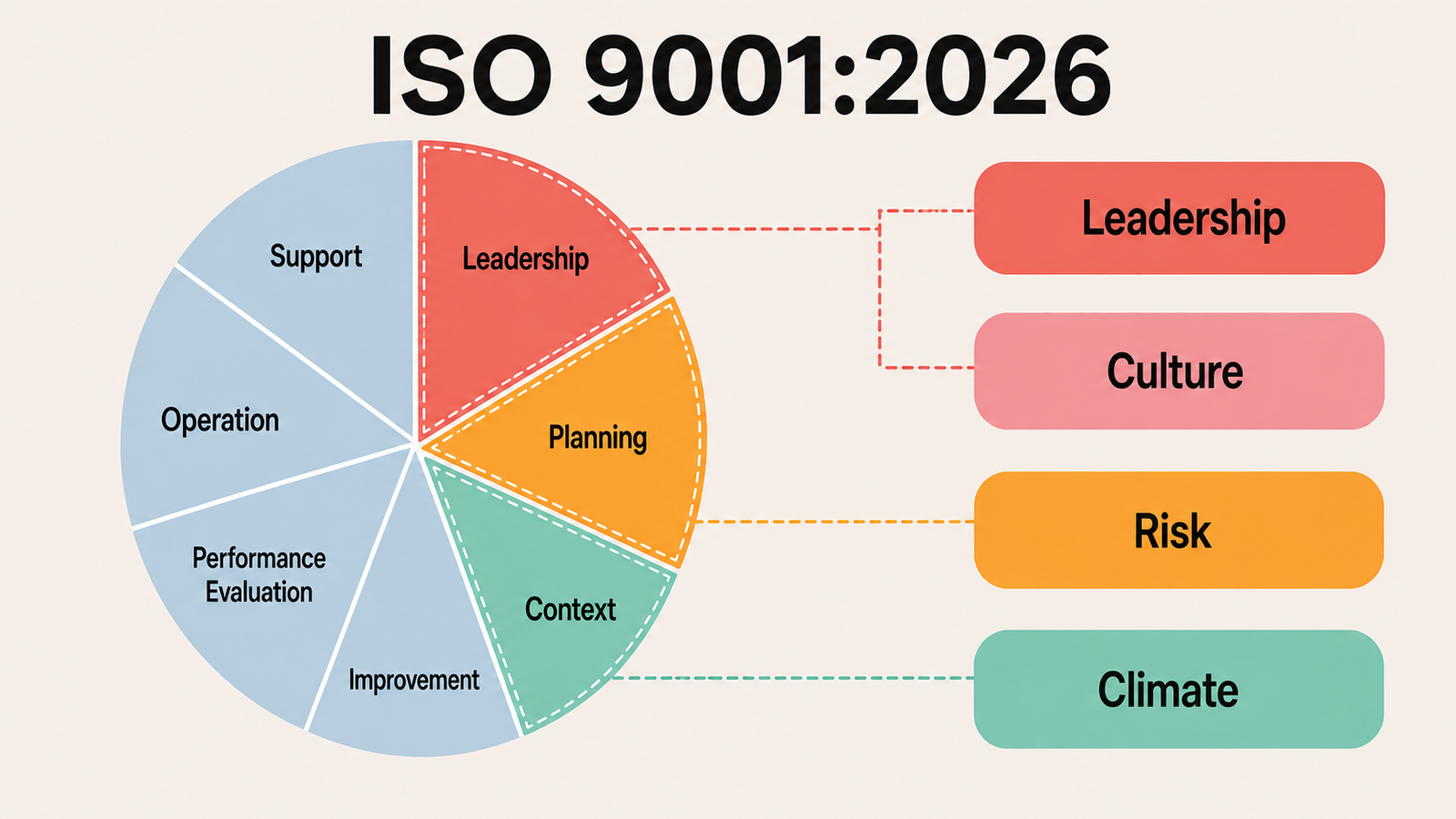
The 2026 draft doesn’t discard that foundation, but it clearly stops treating it as the whole story. According to certification body summaries of the approved draft, the revision strengthens requirements around leadership commitment to quality culture and ethical behaviour, expands how organisations must handle risk and opportunity rather than risk alone, and introduces a formal amendment addressing climate change considerations within an organisation’s context analysis. Quality advisory firm DQS frames the same shift in terms of what’s driving it: a stronger reference to sustainability, digitalisation, and changing stakeholder expectations running through the whole revision, rather than any single new clause.

None of these are things a quality control inspector can sign off on. They live upstream — in how leadership makes decisions, how a company treats the people who notice something is wrong, and how far a business is willing to look into its own supply chain and environmental footprint before calling something “quality.”

The most significant conceptual addition in the 2026 revision goes beyond existing leadership commitment requirements — top management must now explicitly demonstrate a quality culture and ethical behaviour throughout the organisation, not just sign off on a policy.

Why the shift now

It’s tempting to read this as ISO chasing trends — ESG, AI, resilience, the usual list. But the pressure has been building from a fairly specific direction. The pandemic exposed how fragile “quality” promises become when supply chains break. Digitalisation and AI have quietly moved decision-making — and error — further from any single inspection point. And customers, regulators, and investors have all started asking questions that a conformity certificate was never designed to answer: was this made responsibly, and can you prove the culture behind it is sound, not just the paperwork?

One certification body summary puts it plainly: the revision moves ISO 9001 beyond a compliance-driven framework, positioning it instead as a strategic tool for resilience, efficiency, and reputation. That’s a meaningful repositioning for a standard that, for many companies, has functioned mainly as a tender requirement or customer checkbox. Notably, ISO itself has described the revision’s aim as keeping the standard relevant rather than changing it just because it’s ten years old — input has been drawn from user surveys, interpretation requests, and lessons learned from a decade of applying the 2015 edition.

What this means if you're not chasing a certificate

For Singapore’s SMEs and manufacturers, ISO 9001:2026 doesn’t demand an immediate response — the transition window is long, and certification bodies themselves will need roughly 9 to 12 months after publication before they can even begin auditing against the new version. But the direction of travel is worth sitting with regardless of certification status.

Quality culture can't be delegated to a QA manager any more than trust can be delegated to a compliance officer. If leadership isn't visibly living it, an auditor checking a box won't manufacture it after the fact.

If a defect ships, if a supplier cuts a corner, if an employee spots a problem and says nothing — none of that shows up on a quality control checklist until it’s too late. That’s the gap this revision is trying to close: not by adding more inspection, but by asking organisations to be honest about the conditions that produce good or bad outcomes long before anything reaches a checkpoint.

That reframing — quality as a leadership and culture question rather than a QA function — is the thread running through the rest of this series. Next up: a plain-language breakdown of exactly what’s changed between the 2015 and 2026 editions, and which of those changes actually matter for how you run your business.


Disclosure: This article was developed with AI assistance and curated by Mediafacturing. The final editorial direction, review, and publication decision were made by Mediafacturing Editorial Team.

Article audio is generated by AI tool.

Share this article

Related topics

Like our industry analysis?

Add Insights by Mediafacturing as your preferred source on Google.

Latest articles

Have a story, perspective or partnership idea?

We welcome relevant business stories, expert views, company features, event coverage and partner-led insights that are useful to our readers.

Find articles by keyword

Newsletter

Ideas worth following

Join our free weekly newsletter for sharp insights, industry stories, and business perspectives curated for leaders, builders, and decision-makers.

ISO 9001:2026 Is Set To Broaden The Quality Horizon. Leadership, culture, risk, and climate gain greater emphasis.

ISO 9001 2026

AI-assisted image: Created using a human-written editorial prompt.

AI Prompt:

Create a premium editorial infographic in a minimalist, flat 2D vector style. CANVAS AND COMPOSITION * Landscape format, 16:9 aspect ratio. * Soft cream/off-white background, approximately #F8F4EC. * Large circular wheel on the left side, occupying roughly 40% of the canvas width. * Four rounded pill-shaped callout cards stacked vertically on the right. * Maintain generous negative space between the wheel, connectors, cards, headline, and canvas edges. * The composition should feel balanced, architectural, polished, and suitable for a premium business publication. HEADLINE Place the exact headline: “ISO 9001:2026” Position it prominently at the top-center of the entire composition. * Use a clean modern sans-serif typeface such as Inter, Helvetica Neue, or a similar geometric grotesk. * Very large, extra-bold weight. * Dark charcoal or near-black, approximately #1E1E1E. * The headline must be the strongest typographic element and the first thing the viewer notices. * Do not place any subtitle or caption beneath the wheel. LEFT-SIDE WHEEL Create one complete circular pie-style wheel divided into exactly seven clean radial wedges. Every wedge must meet precisely at the center of the circle. Arrange the three highlighted wedges together along the right-facing side of the wheel in this top-to-bottom order: 1. “Leadership” — upper-right wedge 2. “Planning” — middle-right wedge 3. “Context” — lower-right wedge Arrange the four remaining wedges naturally across the top-left, left, lower-left, and bottom portions of the circle: * “Support” * “Operation” * “Performance Evaluation” * “Improvement” A suitable clockwise arrangement is: Support → Leadership → Planning → Context → Improvement → Performance Evaluation → Operation Keep all seven labels correctly spelled and include each label exactly once. WHEEL COLORS Use a restrained pastel palette: * Leadership: soft coral, approximately #FF7065 * Planning: warm mustard-orange, approximately #FFB329 * Context: soft mint green, approximately #7FCBB2 * Support, Operation, Performance Evaluation, and Improvement: the same muted pastel blue-grey, approximately #B7CCDA Use flat or nearly flat color fills with no visible dimensional rendering. WHEEL DETAILS * Separate every wedge with thin, crisp white radial strokes. * Add a thin dashed white inset outline inside the Leadership, Planning, and Context wedges only. * The dashed outlines should follow each highlighted wedge’s outer and radial edges. * Do not outline the four blue-grey wedges with dashed lines. * Use dark charcoal sans-serif labels inside every wedge. * Use a clean medium-to-semibold weight. * Center each label comfortably within its wedge. * “Performance Evaluation” may wrap neatly across two lines. * Keep all labels highly legible. * Do not place icons, arrows, illustrations, numbers, or decorative symbols inside the wheel. RIGHT-SIDE CALLOUT CARDS Create exactly four wide, rounded pill-shaped cards in a vertical stack on the right side. Place them in this exact top-to-bottom order: 1. “Leadership” 2. “Culture” 3. “Risk” 4. “Climate” Card styling: * Leadership card: soft coral matching the Leadership wedge * Culture card: complementary soft dusty pink, approximately #EF9BA5 * Risk card: warm mustard-orange matching the Planning wedge * Climate card: soft mint green matching the Context wedge * Large rounded corners * Flat pastel fills * No borders * No icons * No shadows * No bevels * No glossy effects * Dark charcoal text * Large, bold, centered sans-serif typography * Equal card widths and heights * Generous, consistent vertical spacing CONNECTOR SYSTEM Use thin, precisely spaced dashed connector lines. Match each connector color to its source wedge and corresponding card. Leadership and Culture: * Start one coral dashed line at the outer right-facing edge of the Leadership wedge. * Run it roughly horizontally into the cream-colored gutter between the wheel and cards. * Create one clean vertical branch in the gutter. * Connect the upper branch to the left edge of the Leadership card. * Connect the lower branch to the left edge of the Culture card. * The Culture card must clearly appear as a secondary branch of Leadership, not as a separate source. Risk: * Start one mustard-orange dashed line at the outer edge of the Planning wedge. * Run it directly and approximately horizontally to the left edge of the Risk card. * Do not connect Risk to any other wedge. Climate: * Start one mint-green dashed line at the outer edge of the Context wedge. * Run it directly and approximately horizontally to the left edge of the Climate card. * Do not connect Climate to any other wedge. CONNECTOR REQUIREMENTS * Every connector must visibly originate from the correct colored wedge. * No connector lines may cross, overlap, merge accidentally, or pass through another wedge. * Maintain clear vertical separation between the Leadership/Culture branch, Risk line, and Climate line. * Use precise right-angle corners only where branching is required. * Use the same stroke weight, dash length, and gap spacing throughout. * Do not use arrowheads. OVERALL STYLE * Minimalist flat vector illustration * Premium business-editorial aesthetic * Soft, sophisticated pastel palette * Clean modern typography * Strong alignment and spacing * High readability * Generous negative space * Crisp geometric construction * Calm, authoritative, contemporary visual tone TEXT ACCURACY Render only the following text: * “ISO 9001:2026” * “Leadership” * “Planning” * “Context” * “Support” * “Operation” * “Performance Evaluation” * “Improvement” * “Leadership” * “Culture” * “Risk” * “Climate” Spell every label exactly. Do not add any other text. AVOID No 3D rendering, perspective, extrusion, bevels, gradients, gloss, glow, shadows, reflections, textures, grain, circuit-board patterns, technology-dashboard styling, bar charts, icons, arrows, logos, ISO organization marks, certification seals, watermarks, additional labels, duplicate labels, crossed connectors, or decorative clutter.