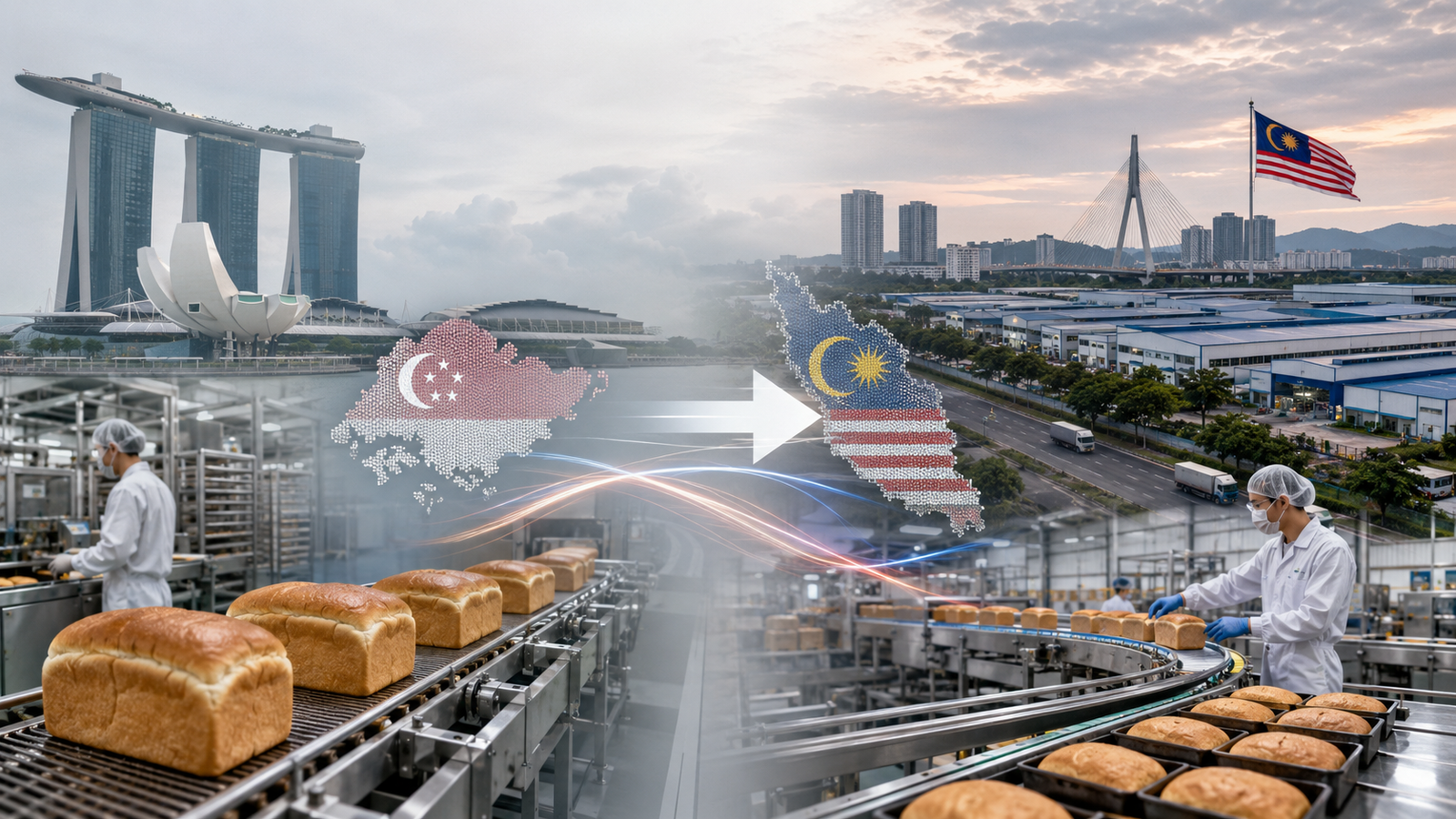
Singapore’s role in food manufacturing is changing, as another familiar F&B brand moves production across the Causeway while keeping key corporate and supply chain functions here.
Gardenia Foods will shift its bakery production from Singapore to Johor Bahru, Malaysia, resulting in the retrenchment of 141 employees at its Pandan Loop facility. Production at the Singapore manufacturing site will cease on 30 June 2026.
The company said the move is part of its ongoing efforts to improve operational efficiency and remain competitive amid a more challenging global environment. Gardenia informed employees of the decision at an internal meeting on 20 May, adding that affected staff will receive the appropriate notice period and support in line with local regulations and guidelines.
Singapore to remain a key hub
While bakery production will move to Johor Bahru, Gardenia said Singapore will continue to serve as its central hub for key functions. These include brand management, product development, quality and regulatory oversight, daily distribution, and supply chain operations. The company expects to retain about 250 employees in Singapore after the transition.
Gardenia’s Singapore team will also continue to oversee quality governance and ensure compliance with requirements set by the Singapore Food Agency and the Health Promotion Board.
The move signals a familiar direction for some manufacturers operating in Singapore: production may be relocated to lower-cost or larger-scale regional sites, while Singapore retains higher-value functions such as management, governance, product development, compliance, logistics, and brand control.
Union support and worker transition
Gardenia said the Food, Drinks and Allied Workers Union was informed in advance of the decision. This allowed the union to mobilise support for affected workers, including training, job placement assistance, discussions on fair retrenchment terms, and access to suitable vacancies through its network of unionised partners.
The company will also sponsor one year of union membership for existing members so that affected workers can continue to access career and financial support. In the coming weeks, the union is expected to organise on-site jobs and skills training, including resume writing and interview preparation.
Part of a wider manufacturing shift
Gardenia’s decision follows similar restructuring moves by other food and beverage manufacturers in Singapore. Earlier in 2026, Yeo Hiap Seng announced that it would lay off 25 employees at its Senoko facility as it shifted can manufacturing operations to Malaysia. Asia Pacific Breweries Singapore also said it would cut about 130 roles as production moves to other regional markets, including Malaysia and Vietnam.
For Singapore, the broader question is not whether manufacturing remains important, but what kind of manufacturing can continue to make sense here. High-volume production faces pressure from land, labour, energy, and operating costs. At the same time, Singapore remains attractive as a base for headquarters functions, quality assurance, regulatory oversight, innovation, and regional supply chain coordination.
Gardenia was established in Singapore in 1978 as a small bakery at Bukit Timah Plaza and began commercial bakery operations at Pandan Loop in 1983. Over the years, the brand has grown into one of Singapore’s most recognisable bread names, with a wider footprint across the Asia-Pacific region.
Impact on food and beverage industry
This development reflects a difficult but important transition in Singapore’s manufacturing landscape. For mature food and beverage brands, the challenge is no longer only about producing locally. It is about deciding which parts of the value chain should remain in Singapore, and which parts can be scaled more efficiently across the region.
The retrenchment of 141 employees is a significant human impact. At the same time, Gardenia’s decision also shows how Singapore-based manufacturing companies may increasingly operate as regional command centres — anchoring brand, quality, product development, compliance, logistics, and market strategy, while production capacity shifts to larger regional facilities.
For policymakers, workers, and SMEs, the lesson is clear: the future of manufacturing in Singapore will depend heavily on upgrading skills, strengthening automation capabilities, and helping workers move into higher-value roles as production models evolve.