Additive manufacturing has spent years being introduced as the future of production.
Better known to many as 3D printing, it promised complex shapes, faster prototyping, lighter parts, less material waste, and more flexible supply chains. For designers and engineers, it opened up possibilities that conventional manufacturing methods could not easily achieve.
But the technology has now reached a more serious phase.
The question is no longer simply whether companies can print parts. It is whether those parts can be trusted in real industrial environments.
That shift matters because additive manufacturing is no longer just a technology story. It is becoming a manufacturing strategy story.
From prototyping to production
Additive manufacturing refers to the process of making parts from 3D model data, usually by joining material layer upon layer, rather than cutting material away through subtractive manufacturing methods. (source)
Its modern roots are often traced to the 1980s, when stereolithography helped establish the idea of building three-dimensional objects layer by layer from digital designs. (source)
For much of its early development, the appeal was clear: speed.
Companies could use 3D printing to produce models, prototypes, patterns and tooling without waiting for expensive moulds or long machining processes. Wohlers Associates notes that additive manufacturing is used for models, prototypes, patterns, tooling and production parts across consumer, industrial, medical and military sectors. (source)
This made additive manufacturing highly valuable in product development. Teams could test ideas, adjust designs, shorten development cycles and reduce the risk of committing too early to a flawed product.
But prototyping was only the beginning.
As machines, materials, software and design methods improved, additive manufacturing began moving into more demanding industrial applications. It became relevant not only for making things quickly, but for making things differently.
Why it matters today
The relevance of additive manufacturing today is not simply that it can produce unusual shapes.
Its deeper value lies in what it allows manufacturers to rethink.
A part can be redesigned to reduce weight. Several components can sometimes be consolidated into one. A replacement part can potentially be produced closer to where it is needed. A low-volume component can be made without the same tooling burden as traditional manufacturing. A product can be customised more easily for specific requirements.
This is why additive manufacturing is increasingly relevant to sectors such as aerospace, healthcare, marine and offshore, precision engineering, tooling, energy and advanced manufacturing.
For companies facing pressure to improve productivity, shorten development cycles, reduce waste and build more resilient supply chains, additive manufacturing offers another production option. It does not replace conventional manufacturing. It expands the manufacturing toolbox.
That distinction is important.
Additive manufacturing is not automatically better because it is newer. Machining, casting, moulding and other established processes will continue to be more suitable for many applications. The value of additive manufacturing depends on the part, the material, the economics, the production volume, the customer requirement and the ability to meet quality expectations.
The future of the technology will therefore depend less on hype and more on practical adoption.
Singapore has built the ecosystem
Singapore has not treated additive manufacturing as a passing trend.
The National Additive Manufacturing Innovation Cluster, or NAMIC, states that it works with enterprises to accelerate the adoption of hybrid and digital additive manufacturing technologies in Singapore. Its published achievements include more than 5,800 organisations engaged, more than 550 projects initiated and more than 320 projects approved. (source)
The country’s efforts are not new. In a 2021 speech, the Ministry of Trade and Industry noted that Singapore had invested significantly into public additive manufacturing infrastructure as part of its Research, Innovation and Enterprise strategies, and that NAMIC was established in 2015 to accelerate Singapore’s adoption of additive manufacturing technologies. (source)
That matters because additive manufacturing needs more than machines.
It needs researchers, engineers, material specialists, software capability, design knowledge, testing infrastructure, business adoption pathways and standards. It also needs companies willing to experiment, but disciplined enough to turn experiments into repeatable capability.
Singapore’s additive manufacturing ecosystem has already moved past the awareness phase. The harder question now is whether these capabilities can translate into broader industrial adoption.
The future opportunities are real
The opportunity for additive manufacturing is especially strong where conventional manufacturing faces constraints.
In aerospace and MRO, additive manufacturing can support repair, replacement, lightweighting and low-volume specialised parts. In marine and offshore, it can support spare parts, repair and large-format applications. In healthcare, it can enable customised devices, implants, dental products and medical models. In precision engineering, it can support jigs, fixtures, tooling and complex components.
It also has relevance in sustainability discussions because additive processes can reduce material waste in some applications compared with subtractive methods. MTI has previously linked additive manufacturing with sustainable manufacturing, noting that NAMIC 2.0 would deepen capabilities in AI, automation and additive manufacturing, which can conserve energy and reduce waste compared with traditional subtractive manufacturing methods. (source)
But the biggest opportunity may not be in any single sector.
It may be in giving manufacturers more flexibility.
Additive manufacturing allows companies to think differently about inventory, design, product development and supply-chain response. Instead of holding every spare part physically, some companies may eventually hold more parts digitally. Instead of waiting for long tooling cycles, some may use additive methods to accelerate development or produce low-volume components.
This does not mean the factory of the future will print everything.
It means the factory of the future may need to know when printing makes sense.
The adoption challenge
The challenge is that additive manufacturing is easy to admire, but harder to adopt well.
For many SMEs, the key question is not whether they should buy a 3D printer. The better question is where additive manufacturing fits into their business.
Is it for prototyping? Tooling? Spare parts? Repair? Product customisation? Low-volume production? Design improvement? Customer demonstration? Research collaboration?
Without a clear use case, additive manufacturing can become an expensive showcase rather than a serious business capability.
There are also capability gaps. Companies may need design-for-additive-manufacturing knowledge, material understanding, machine operation skills, inspection methods, post-processing capability and quality systems. They may also need partners who can help them test, validate and commercialise applications.
This is where the conversation becomes less exciting, but more important.
Industrial adoption is not driven by technology alone. It is driven by repeatability, economics, customer confidence and trust.
The next phase is trust
This is why the next phase of additive manufacturing is not just printing.
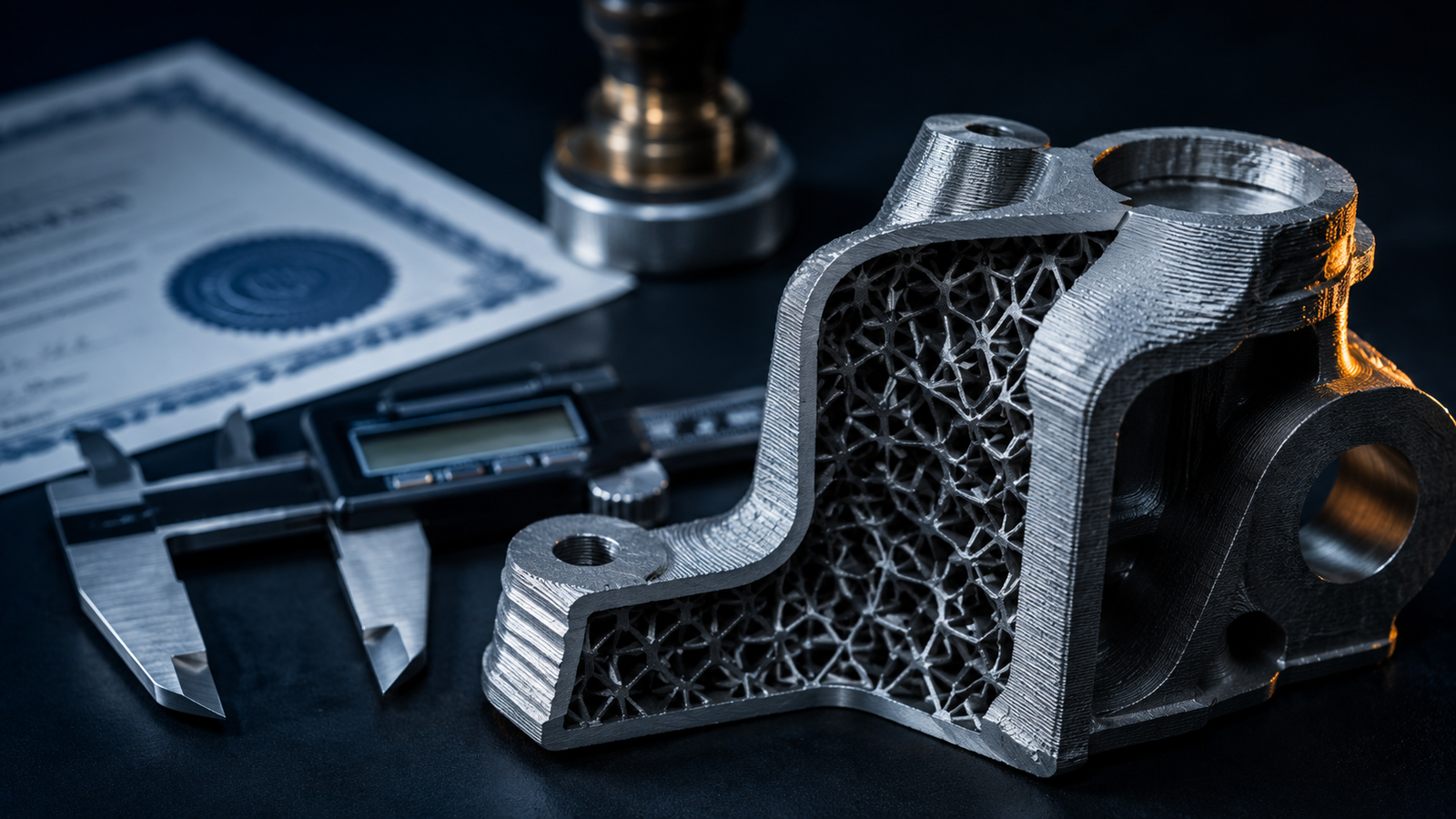
It is qualification.
A printed part may look successful. It may perform well in a demonstration. It may even solve a technical problem. But in serious industrial environments, that is not enough.
Manufacturers and customers need to know whether the process can be controlled. They need to know whether material properties are consistent. They need to know whether inspection methods are reliable. They need documentation, traceability and confidence that the same outcome can be repeated.
In regulated or safety-critical sectors, this becomes even more important.
Singapore’s launch of SS 708 in March 2025 is a useful signal of where the industry is heading. Enterprise Singapore said the Singapore Manufacturing Federation – Standards Development Organisation and EnterpriseSG, through the Singapore Standards Council, launched SS 708, a Singapore Standard for additive manufacturing for aerospace filament layer manufacturing process specifications, at inter airport Southeast Asia 2025. It is described as Singapore’s first standard developed in additive manufacturing for aerospace and part of wider efforts to strengthen Singapore’s position as a leading aerospace maintenance, repair and overhaul hub in Asia Pacific. (source)
That is significant.
Aerospace is not a casual use case. It is a sector where quality, safety, traceability and repeatability matter deeply. If additive manufacturing can gain more ground in such environments, it will have to do so through standards, qualification and certification — not just technical enthusiasm.
A*STAR SIMTech’s masterclass on qualification and certification for additive manufacturing also points in the same direction. The programme covers requirements and routes to validation for metal AM parts produced by powder-bed fusion and directed energy deposition, is based on ISO and ASTM standards, and is intended for users working with serial or critical applications.
In other words, the industry conversation is maturing.
The question is no longer only: can this part be printed?
The more important question is: can this part be qualified for real use?
From innovation showcase to manufacturing discipline
Additive manufacturing has come a long way.
It has moved from a prototyping tool to a serious part of advanced manufacturing conversations. It has become relevant to product development, repair, customisation, supply-chain resilience and industrial transformation.
But the next stage will be harder than the last.
It will require companies to move from experimentation to discipline. It will require better translation between research institutions, technology providers, standards bodies and industry users. It will require manufacturers to understand not only what additive manufacturing can do, but where it makes commercial and operational sense.
For Singapore, this is where the opportunity lies.
The country is unlikely to compete on low-cost mass production. Its manufacturing advantage has to sit in higher-value capabilities: advanced engineering, trusted production, quality systems, regional coordination and specialised industrial know-how.
Additive manufacturing fits that ambition, but only if it is treated seriously.
The next phase is not about proving that Singapore can print parts. That has already been demonstrated.
The next phase is about proving that those parts can be qualified, accepted and used in the real world.
That is a much harder challenge.
It is also where additive manufacturing starts to become real manufacturing.