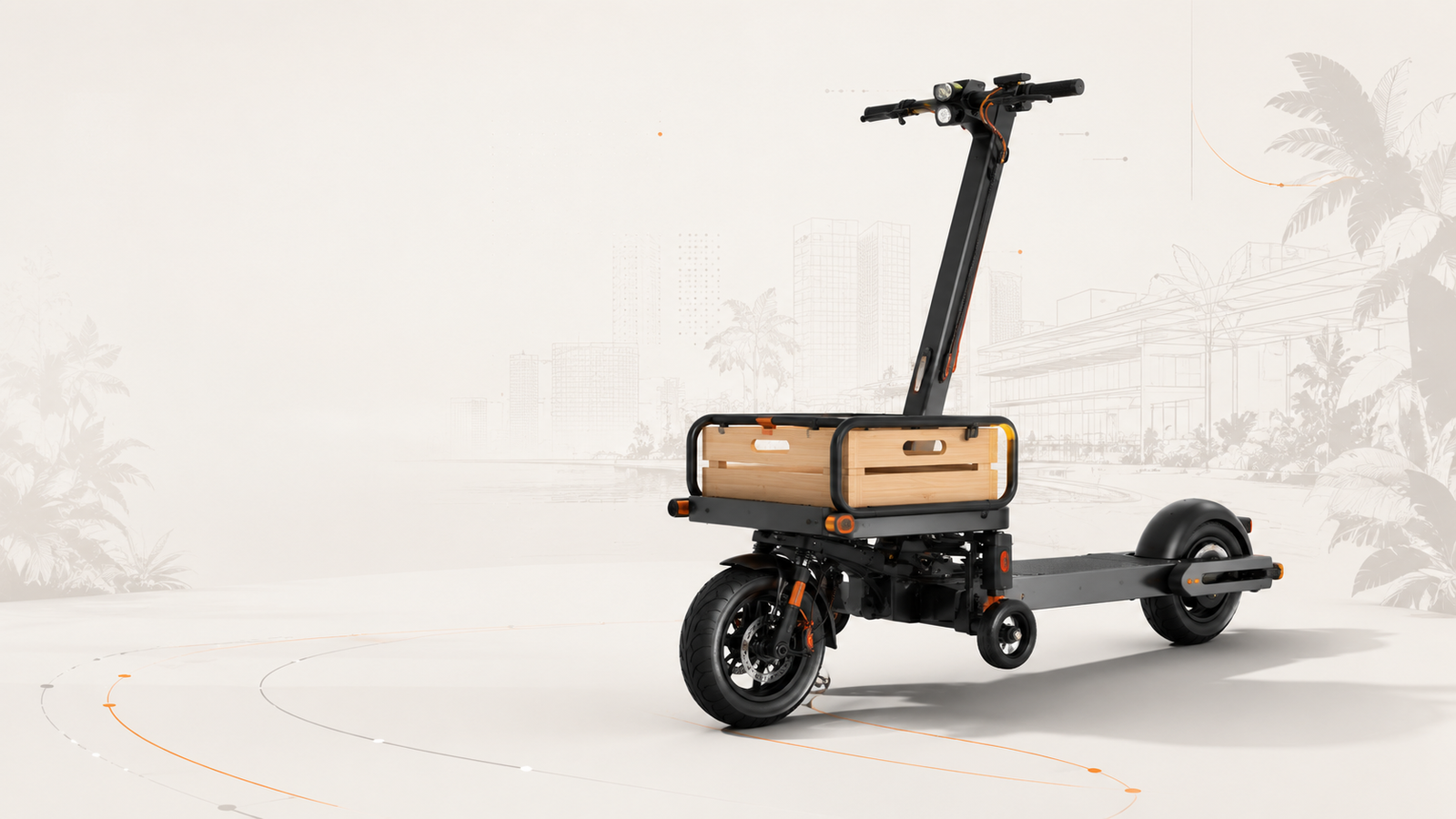
MIMO Motor is a Singapore-based mobility startup founded by Witono Halim. The company focuses on compact mobility devices that can help people and businesses move both riders and cargo through dense urban environments. Solar Impulse lists MIMO Motor as having been founded in 2016, with its headquarters in Singapore. (source)
The company’s name is closely tied to the idea of micro-mobility: smaller, lighter and more practical vehicles that can serve short-distance journeys without relying on cars or vans. NUS Enterprise describes MIMO’s original thinking as an attempt to combine the advantages of a cargo scooter and a trolley, creating a portable solution that could support movement from the start to the finish of a trip. (source)
MIMO’s broader ambition is not simply to make another personal transport device. It is trying to solve a more specific urban problem: how to move goods efficiently in cities where roads are congested, delivery demand is rising, and large vehicles are often inefficient for short, fragmented trips.
From cargo e-scooter to cargo bicycle
MIMO first gained attention with the MIMO C1, a transformable cargo e-scooter designed for first- and last-mile delivery. The C1 could function as both a rideable e-scooter and a trolley, making it suitable for delivery riders who needed to move between roads, paths, malls and indoor spaces. MIMO says it partnered with Grab and Roadbull in 2019 for a pilot project involving the C1, but collaboration plans were later affected by Singapore’s regulatory changes around e-scooters. (source)
The C1 also received overseas attention. MIMO says the product won the Movin’On Startup Challenge by Michelin for its impact on sustainable mobility, and received the Solar Impulse Efficient Solution label in 2020. (source)
However, the regulatory context needs to be stated carefully. It is not accurate to say that e-scooters are banned outright in Singapore. Under current Land Transport Authority rules, e-scooters are treated as motorised personal mobility devices. They must meet requirements such as a maximum weight of 20kg, maximum width of 70cm, maximum motorised device speed of 25km/h, UL2272 certification, registration with LTA, and other user requirements before they can be used on cycling paths. (source)
For the Singapore market, this distinction is important because MIMO’s current product direction have moved from the earlier cargo e-scooter concept to a cargo bicycle format. As of May 2026, the MIMO Nomad, described as an adaptable cargo bicycle built for everyday life, is available for clients to preorder. The published specifications list a dry weight of around 15kg, length of around 175cm, cargo payload of 50kg, rider payload of 120kg, a 7-speed Shimano drivetrain, and 16-inch front and 20-inch rear wheels. (source)
Sustainable last-mile transportation
MIMO Motor is trying to make cargo mobility smaller, more flexible and more usable for everyday urban life. Instead of approaching delivery and transport through the lens of full-sized vehicles, the company is exploring a middle ground between bicycles, trolleys, scooters and cargo bikes.
That middle ground matters. A normal bicycle may be too limited for heavier goods. A van may be too large, costly or inefficient for short neighbourhood trips. A conventional cargo bike may be useful, but bulky. MIMO’s opportunity lies in designing a device that is compact enough for dense Asian cities, but useful enough to carry meaningful cargo.
The Nomad reflects this direction. MIMO Motor positions it as a compact cargo bicycle “without the bulk of a traditional cargo bike”, with an interchangeable front interface that allows users to swap configurations depending on need. (source)
Relevance of sustainable last-mile transportation
Last-mile delivery is becoming a bigger operational, environmental and urban-planning issue. E-commerce, food delivery, healthcare delivery, grocery delivery and small-parcel logistics have all increased the pressure on city transport systems. Regionally, Southeast Asia’s digital economy continues to grow. The 2025 e-Conomy SEA report by Google, Temasek and Bain projects Southeast Asia’s digital economy to surpass US$300 billion in GMV by 2025, with e-commerce projected to reach US$185 billion in GMV. Food delivery is also projected to reach US$23 billion in GMV in 2025. (source)
In Singapore, the last-mile delivery market is also expected to grow. Mordor Intelligence estimates Singapore’s last-mile delivery market at US$14.53 billion in 2026, with a forecast to reach US$25.57 billion by 2031. It identifies e-commerce penetration, same-day delivery demand, cross-border micro-shipments, locker networks and cold-chain logistics as key drivers. (source)
This creates space for smaller, cleaner and more flexible delivery formats. Not every parcel needs a van. Not every business delivery requires a motorcycle. For dense neighbourhoods, campuses, business parks, mixed-use estates and short-range delivery zones, compact cargo bikes could become a practical part of the delivery mix.
The regulatory challenge
For MIMO, the challenge in Singapore and globally is not only product-market fit. It is also the territorial regulatory fit.
For example, Singapore has tightened its active mobility rules over the years to improve safety on paths and roads. LTA’s current rules distinguish between manual bicycles, power-assisted bicycles, motorised PMDs, e-scooters, personal mobility aids and other devices. Manual bicycles and three-wheeled pedal cycles used on public paths must meet a maximum weight of 20kg, maximum width of 70cm, and have at least one functioning handbrake. On roads, they must meet a maximum width of 130cm and maximum length of 260cm. (source)
That means MIMO Motor’s current cargo bicycle direction may be more compatible with Singapore’s active mobility environment than its earlier cargo e-scooter concept, but compliance still depends on the final device configuration. The published weight and length of the Nomad appear promising, but path use would still depend on details such as width, configuration, rider behaviour and applicable device category.
This is where MIMO’s story becomes more interesting than a simple startup profile. It shows how mobility innovation must be designed not only around engineering and sustainability, but also around safety rules, public infrastructure and social acceptance.
The infrastructure opportunity
Singapore is also building the physical environment that could support more active mobility use. LTA says there are now more than 730km of cycling paths and park connectors across Singapore, and that the cycling network is planned to reach about 1,300km by 2030. (source)
For cargo mobility, this infrastructure matters. More cycling paths do not automatically mean cargo bikes will become mainstream, but they create a more credible operating environment for right-sized delivery vehicles. The opportunity is especially strong where trips are short, routes are predictable and cargo loads are moderate.
Possible use cases include estate-level delivery, campus logistics, business park operations, facility management, retail restocking, events, food delivery, neighbourhood fulfilment and small-business logistics. These are areas where a compact cargo bike could reduce reliance on larger vehicles without requiring a complete redesign of the logistics network.
What to expect in the future of sustainable last-mile delivery
The next phase of sustainable last-mile delivery is unlikely to be defined by a single vehicle type. Instead, the market is likely to move towards a more mixed delivery system.
Large vans and trucks will still handle bulk movement. Electric vans may serve commercial fleets. Motorcycles and bicycles will continue to serve food and parcel delivery. But compact cargo bikes, parcel lockers, micro-fulfilment nodes, route optimisation software and specialised cold-chain delivery may play a larger role in reducing unnecessary vehicle trips.
For Singapore, the most practical developments may come from controlled environments first: campuses, business parks, town centres, industrial estates, tourism precincts, healthcare routes and neighbourhood logistics zones. These environments allow operators to test safety, routing, loading, charging, maintenance and cost savings before scaling more widely.
MIMO Motor sits within this emerging space. Its journey from the C1 cargo e-scooter to the Nomad cargo bicycle shows how Singapore startups can adapt to regulatory realities while continuing to pursue sustainable mobility. The larger question is no longer whether cities need cleaner last-mile delivery. They do. The question is which form factors will be practical enough, compliant enough and affordable enough to be adopted at scale.
For MIMO Motor, the opportunity is clear: design the right-sized vehicle for the right-sized trip — and prove that sustainable cargo mobility can work not just as a concept, but as a daily operating tool for cities.