In Brief
- Singapore’s medtech manufacturing output grew from S$5.2 billion in 2013 to S$19.4 billion in 2023, with more than 400 global and local enterprises in the ecosystem.
- The HSA Singapore Medical Device Register (SMDR) contains 20,860 product registration records as of April 2026.
- 96.3% of the SMDR product owners are based overseas.
- Local SME opportunities may sit in quality systems, regulatory support, precision manufacturing, and market-access services.
Singapore’s medtech industry is framed as a manufacturing success story. According to the Singapore Economic Development Board, the sector’s manufacturing output grew from S$5.2 billion in 2013 to S$19.4 billion in 2023, supported by more than 400 global and local enterprises and approximately 17,000 workers. When examined at a deeper layer, opportunities for Singapore SMEs may sit one layer deeper.
Singapore’s medtech sector is not only a factory-output story. It is also a regulatory, quality, product-registration, and market-access ecosystem. And a closer reading of the public data shows that those functions may be just as consequential as what happens on the production floor.
What the Singapore Medical Device Register shows
The Singapore Medical Device Register (SMDR), maintained by the Health Sciences Authority and published on data.gov.sg, provides a public dataset of all registered Class B, C, and D medical devices. The April 2026 edition contains 20,860 records covering device name, intended use, medical specialty, risk classification, product owner, registrant, and model details.
How we read the data
Insights analysed the April 2026 Singapore Medical Device Register dataset published on data.gov.sg. Each row was treated as a product registration record, not a unique company or product family. Unique registrants and product owners were counted based on registered names as they appear in the dataset. Product-owner location was inferred from the address field.
Two things need to be said clearly about this dataset. First, the records are product registrations, not company counts. Second, the structure of those registrations reveals something important about Singapore’s role in the global medtech supply chain.
Of the 20,860 records, 96.3% have a product owner based outside Singapore. And in 99.6% of all records, the registrant and the product owner are not the same entity. Under HSA’s registration framework, foreign device manufacturers must appoint a Singapore-based registrant to manage submissions, hold the licence, and correspond with HSA on their behalf. The local registrant is not a passive filing agent. It holds the registration, carries the regulatory obligations, and is responsible for ongoing compliance, change notifications, and post-market responsibilities.
This means Singapore’s 870 unique registrants in the SMDR dataset are not simply representing local manufacturers. They are functioning as the regulatory interface for 4,401 distinct product owners, the overwhelming majority of which are headquartered abroad.
"In 99.6% of all SMDR records, the registrant and product owner are different entities. Singapore's local medtech economy includes companies whose primary function is to bring devices in, manage regulatory submissions, and maintain post-market obligations on behalf of overseas manufacturers."
This is what market-access infrastructure looks like in practice.
The risk profile of the registered market
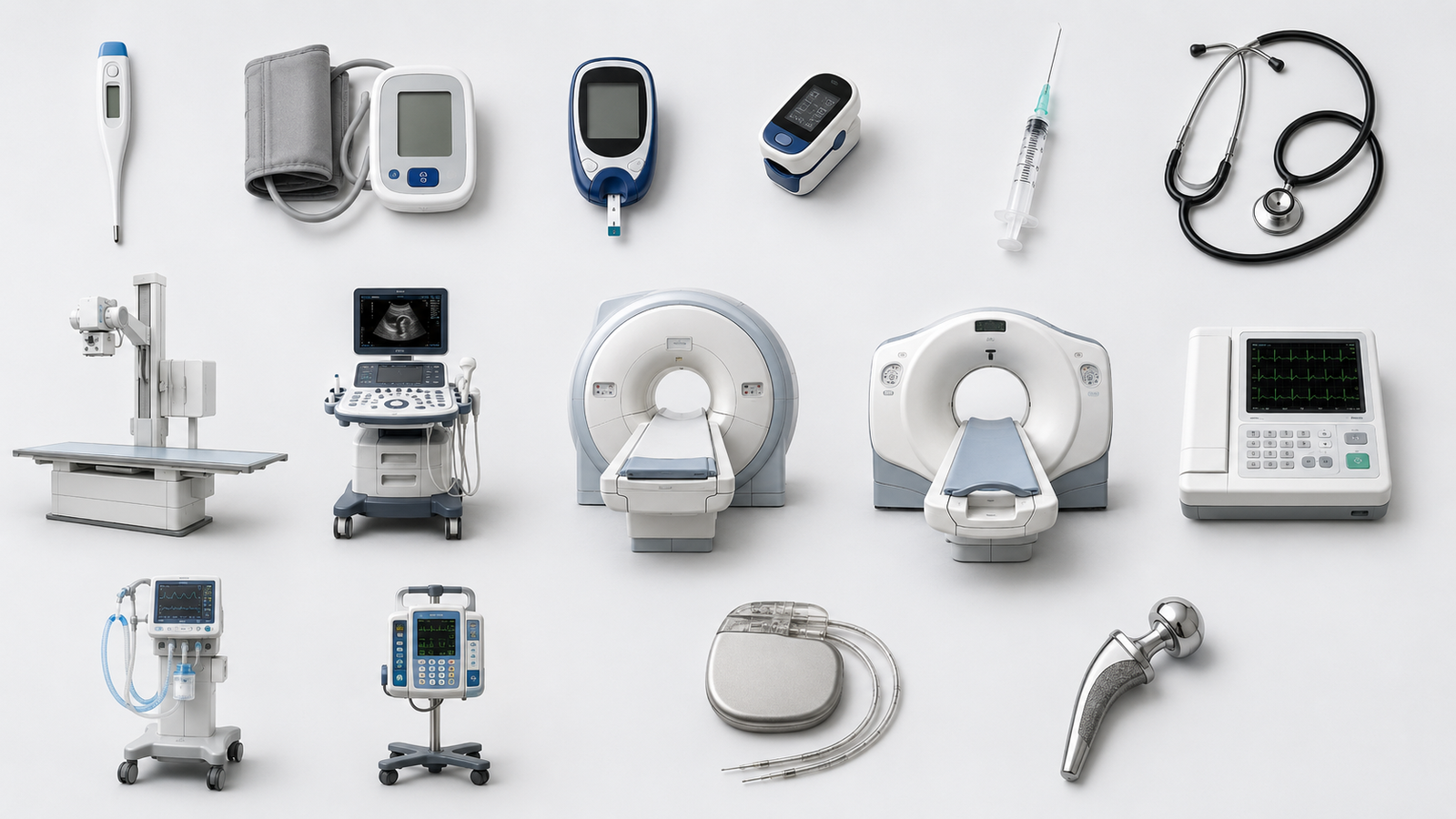
The class breakdown of the SMDR adds another dimension. Class B devices—moderate-risk products such as hypodermic needles, surgical gloves, and certain diagnostic instruments—account for 57.4% of the register. Class C devices, which carry higher risk and include products such as ventilators, orthopaedic implants, and advanced diagnostics, make up 30.2%. Class D devices, the highest-risk category covering items such as pacemakers, implantable neurostimulators, and devices incorporating medicinal products, account for the remaining 12.4%.
The implication is that Singapore’s registered-device landscape is not dominated by low-risk consumables. Nearly 43% of the SMDR consists of Class C and D devices, which require more substantial regulatory dossiers, stronger quality system evidence, and more rigorous post-market obligations. Under HSA’s framework, manufacturers of Class B, C, and D medical devices must hold ISO 13485 certification from an accredited certification body or an accepted equivalent such as MDSAP as a condition of their dealer’s licence. The same applies to importers and wholesalers, though the latter may alternatively use Singapore’s own Good Distribution Practice for Medical Devices Standard (GDPMDS).
The specialty spread of the register is equally broad. General hospital devices form the largest single category with 4,137 records, followed by cardiovascular (1,715), general and plastic surgery (1,659), dental (1,646), orthopaedics (1,637), immunology (1,405), and ophthalmology (1,385). Radiology and imaging, clinical chemistry, and gastroenterology and urology each exceed 1,000 records. Across at least fifteen distinct specialty areas, Singapore’s registered-device landscape serves hospitals, surgical environments, diagnostics, laboratory medicine, and specialised clinical settings in roughly equal measure.
Why Singapore's regulatory standing matters more than it did
The context behind these numbers shifted materially in March 2026. Following a comprehensive assessment using WHO’s Global Benchmarking Tool Plus for Medical Devices, HSA achieved Maturity Level 4 (ML4)—the highest classification in WHO’s framework for national regulatory authorities. Singapore became the first WHO member state in the world to reach this designation specifically for medical devices.
The ML4 classification confirms that HSA operates at an advanced level of performance with mechanisms for continuous improvement, covering market authorisation, clinical evaluation, post-market surveillance, and laboratory testing. HSA CEO Adjunct Prof Raymond Chua noted at the announcement that the achievement comes as HSA is simultaneously expanding its economic development role to benefit the biomedical industry.
"Singapore is not only a place where devices are manufactured. It is increasingly a place where a regulatory decision carries weight globally—and where companies can use a successful HSA registration as a springboard into the broader ASEAN market."
For device makers, this matters operationally. Singapore uses the ASEAN Common Submission Dossier Template (CSDT), which is also the submission format for several other regional markets. A well-constructed HSA dossier can be adapted for Malaysia, Thailand, the Philippines, and Indonesia. HSA also accepts prior approvals from five reference agencies—US FDA, EU Notified Bodies, Health Canada, Australia’s TGA, and Japan’s PMDA—to qualify for faster abridged or expedited evaluation routes. Under the Malaysia-Singapore regulatory reliance arrangement made permanent from March 2026, a successful HSA approval now creates a direct fast-track pathway into Malaysia’s market as well.
The regulatory system, in other words, is not just a market-entry requirement. It is a multiplier.
Where the SME opportunity lies
The economic scale of Singapore’s medtech sector is now well-documented. EDB data shows that more than 2,700 precision engineering and Electronic Manufacturing Services (EMS) providers are already part of the ecosystem, supplying components and turnkey production support to multinational manufacturers. About 70% of medtech manufacturers in Singapore conduct R&D locally. The country produces one in seven hearing aids used worldwide, nine in ten gene expression chips, and one in five cardiac implants.
But the SMDR tells a more granular story about where local capability is actually needed. Because almost all registered devices involve a Singapore-based registrant distinct from the overseas product owner, the demand for professional regulatory and compliance services is structural rather than incidental. Companies that understand technical documentation, design controls, supplier qualification, risk management, complaint handling, and post-market surveillance have a built-in market—not as optional service providers, but as mandatory participants in the registration chain.
For SMEs, this suggests at least four entry points into the sector that do not require inventing a new device.
The first is precision manufacturing. Medtech requires high-tolerance machining, clean assembly, materials expertise, and validated production. Singapore’s existing manufacturing base in aerospace, semiconductors, and electronics already demonstrates these capabilities, and EDB has highlighted these suppliers as a strategic asset that MNCs rely on to shorten time-to-market and maintain quality standards.
The second is quality systems. ISO 13485 certification is a regulatory requirement, not a market differentiator. Companies that help medtech firms establish, audit, and maintain compliant quality management systems are serving a need that every Class B, C, and D manufacturer in Singapore must meet. The same applies to documentation support, internal audit services, and regulatory training.
The third is regulatory and market-access support. As device portfolios become more software-driven, connected, and AI-enabled, the complexity of regulatory submissions is increasing. HSA’s Innovation Office and its engagement with the International Medical Device Regulators Forum signal a sustained commitment to proactive regulatory guidance. Start-ups and SMEs entering the sector often struggle not at the invention stage, but at translation—moving from a working prototype to a documented, validated, registered product. Firms that specialise in bridging that gap are addressing a genuine bottleneck.
The fourth is productisation. Singapore’s MedTech Catapult initiative, flagged in the Ministry of Trade and Industry’s statements on the sector, is specifically aimed at supporting design, development, verification, and validation for companies trying to move from concept to commercialisation. This creates demand for engineering services, testing support, and clinical validation partnerships that can involve local SMEs throughout the development process.
Reading the data carefully
The SMDR is a useful map, but it has limits that matter.
The register does not disclose how many companies in Singapore hold ISO 13485 certification, how many manufacture locally versus distribute, or how many product owners are genuinely Singapore-based versus using local entities as regulatory proxies. The 870 unique registrant names visible in the dataset cannot be interpreted as 870 certified medtech manufacturers. Some are regulatory affairs consultancies. Some are trading companies. Some are dedicated Singapore subsidiaries of multinational groups. The register does not distinguish between them.
Similarly, the 20,860 product records represent distinct registrations, not distinct products in active distribution. A single product may carry multiple records if it covers multiple device models under different registration numbers.
The accurate reading is this: Singapore has a sizeable and growing medtech industry by output, employment, and enterprise count—and an even larger regulated-product ecosystem when viewed through the HSA register. The gap between the two is where local capability, local regulatory infrastructure, and local market-access services actually operate.
What the picture adds up to
Singapore’s medtech sector is already large. But the next phase of its growth will be defined less by how many more factories are established, and more by how well companies—large and small—can combine engineering, compliance, clinical understanding, and regulatory trust in a market where all four are required.
The SMDR shows what that market actually looks like from the inside. It is not a list of manufacturers. It is a record of obligations—and of the Singapore-based entities that have chosen to take them on.
For SMEs assessing where to direct their capabilities, that distinction may be the most useful starting point available.
Data in this article is drawn from the HSA Listing of Registered Medical Devices (April 2026 edition), published on data.gov.sg. Figures cited from EDB refer to the Singapore Economic Development Board’s Census of Manufacturing Activities 2023 and published industry pages.