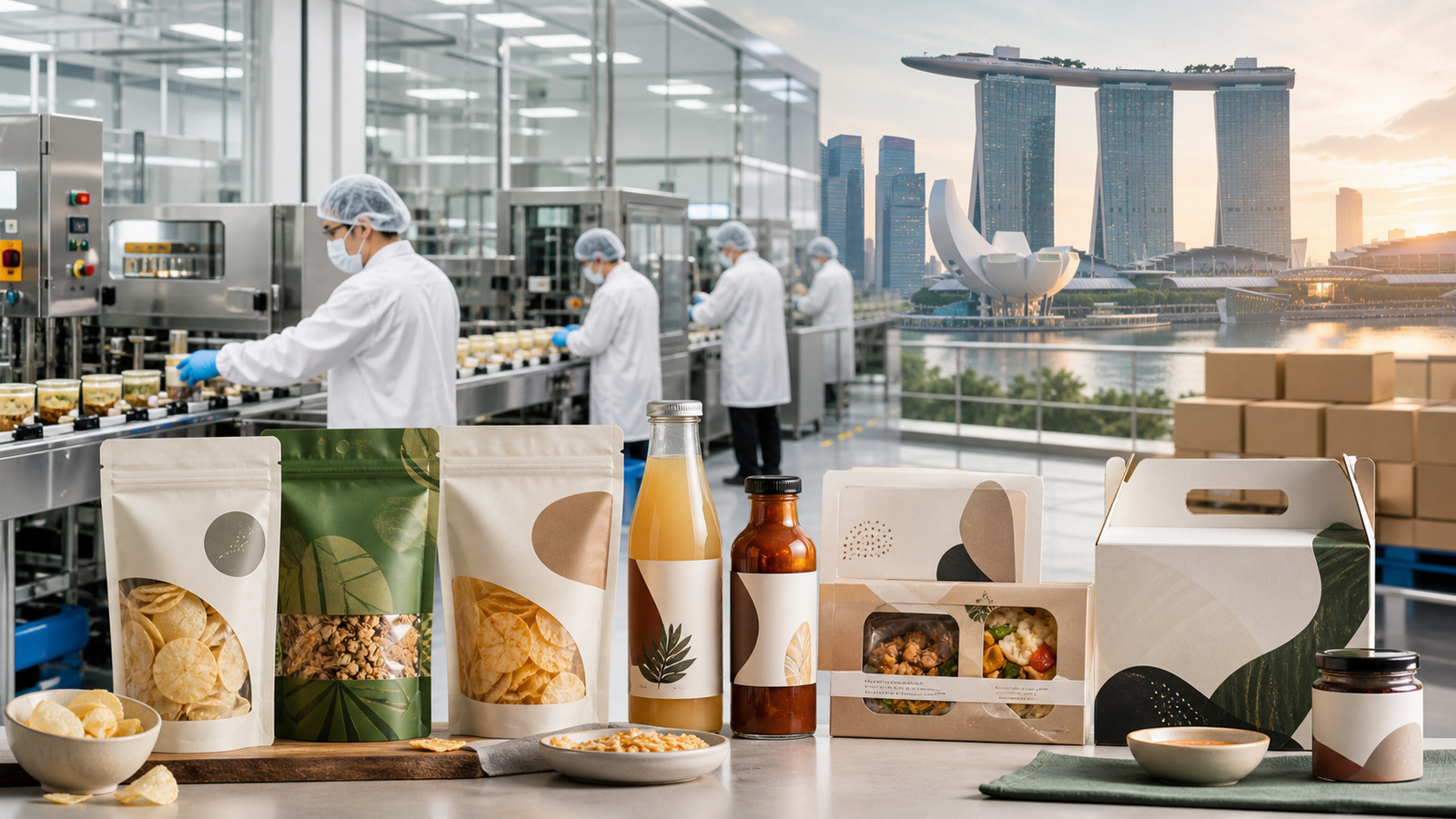
For many years, the strength of Singapore’s food manufacturing sector was often discussed in practical terms: food safety, production quality, export readiness, packaging, certification and operational reliability.
These remain important. But they may no longer be enough.
A visible shift is taking place. Singapore food manufacturers are increasingly moving beyond the role of producers. They are becoming brand builders — companies that do not simply manufacture food products, but design product identities, build consumer trust, create export-ready narratives and develop channels that connect them directly with customers, distributors and regional markets.
This shift was clear at FHA Food & Beverage 2026, where the Singapore Food Manufacturers’ Association and Enterprise Singapore led local companies under the Singapore Pavilion. The showcase was not positioned only around production capability. It highlighted products that combine tradition with innovation, including sauces, ready-to-eat and ready-to-cook options, snacks, beverages and other food products aimed at collaboration, distribution and global partnerships. (Source)
That matters because manufacturing is no longer just about making. It is about being remembered.
From factories to market-facing brands
The traditional food manufacturing model is relatively straightforward: develop a product, produce at scale, supply to retailers, distributors, food service operators or private-label customers.
But the modern food business is becoming more demanding. Retail shelves are crowded. Consumers are more selective. Distributors want products that already come with a story. Export markets expect clearer positioning. Digital platforms have made it easier for smaller brands to reach customers, but also harder to stand out.
In this environment, a good product is only the starting point. A manufacturer now needs a clear brand identity, packaging that communicates value quickly, product claims that are credible, and a distribution strategy that works across both physical and digital touchpoints.
This is where Singapore manufacturers have an opportunity. The country already has a reputation for quality, safety, reliability and international business standards. But those advantages need to be translated into brands that consumers and partners can recognise.
Zixin Group as a useful signal
One example is Zixin Enterprise (Singapore), part of Zixin Group. In April 2026, the company announced progress in the Singapore market, including the introduction of its NutriRootz brand. The brand focuses on snacks and food products derived from sweet potatoes, with segments such as NutriRootz Crunch and NutriRootz Go covering products like crispy sweet potato chips, fries and ready-to-eat sweet potato products. (Source)
Its Singapore Food Manufacturers listing also shows a broader product portfolio, including NutriRootz Crunch Sweet Potato Chips, NutriRootz Crunch Sweet Potato Fries, NutriRootz Sweet Potato Powder and NutriRootz Go Ready-To-Eat Sweet Potato. (Source)
The important point is not merely that another food product has entered the market. The more interesting point is how the product is being framed.
Zixin is not presenting itself only as a supplier of sweet potato products. It is building around health, convenience, traceability, functional food concepts and brand identity. The company also stated that NutriRootz will be introduced in Singapore, Indonesia, Malaysia, Vietnam and Mexico over six months, with the brand playing a central role in its strategy to build scalable, intellectual property-driven food brands across Southeast Asia and beyond.
This is the direction more food manufacturers may need to study.
The future value of a food manufacturing company may not sit only in its production line. It may sit in the combination of product innovation, brand ownership, distribution channels, intellectual property, packaging design, consumer trust and market access.
Why brand-building matters for food manufacturers
Brand-building is sometimes misunderstood as “making things look nice”. For food manufacturers, it is much more strategic.
A strong brand helps a manufacturer move away from pure price competition. Without a brand, the company is often compared on cost, volume and ability to fulfil orders. With a brand, the company can compete on meaning, trust, product experience and market fit.
This is especially important for Singapore companies because local manufacturing costs are not always the lowest in the region. Competing purely on price may not be sustainable. But competing on trust, quality, safety, innovation and premium positioning gives Singapore food companies a better chance of defending margins.
Brand-building also supports export. Overseas buyers do not only want a product; they want to understand why the product exists, who it is for, how it is different, and whether it can sell in their market. A manufacturer with a clear brand story makes the distributor’s job easier.
This is why trade shows such as FHA are important. FHA describes itself as a platform where Asia’s F&B and hospitality industry connects and where brands can be discovered, with exposure to buyers, distributors and partners across food, beverage and hospitality segments.
For Singapore manufacturers, the booth is no longer just a place to display samples. It is a stage to show brand maturity.
The new food manufacturing playbook
The next phase of food manufacturing growth will likely require companies to think across five layers.
First, manufacturers need product innovation. This includes healthier formulations, convenience formats, functional ingredients, ready-to-eat options, ready-to-cook meals, premium snacks and products suited to changing consumer lifestyles.
Second, they need brand architecture. A company may manufacture many products, but it needs to organise them into clear product lines or brands that customers can understand. Zixin’s NutriRootz example shows this through segments such as Crunch, Go and Raw.
Third, they need packaging and storytelling. Packaging is no longer just a container. It is a communication surface. It must explain the value of the product quickly: healthier, cleaner, more convenient, more authentic, more premium, more sustainable or more suitable for modern lifestyles.
Fourth, they need channel strategy. A food manufacturer can no longer rely only on one route to market. Retail, e-commerce, food service, distributors, trade shows and partnerships may all play different roles.
Fifth, they need trust signals. For Singapore companies, this can include food safety, certifications, traceability, clean-label claims, product testing, sustainability practices and transparent sourcing.
These are not just marketing activities. They are business infrastructure.
What this means for SMEs
For smaller food manufacturers, the lesson is not that every company must immediately become a consumer brand. Some may still do well as contract manufacturers, ingredient suppliers or B2B producers.
But even B2B manufacturers need stronger positioning.
A bakery supplier, sauce maker, snack producer or frozen food company should be able to answer simple questions clearly: What do we stand for? Why should buyers trust us? What makes our products different? Which markets are we built for? How do we help our partners sell more?
The companies that answer these questions well will have an advantage.
Singapore’s food manufacturing sector has long had the capability to produce. The next challenge is to create products that travel better, communicate better and remain memorable after the trade show ends.
The bigger opportunity
The broader opportunity is for Singapore food manufacturers to become not just exporters of products, but exporters of branded food concepts.
This is where Singapore can punch above its weight. The country may not have the largest domestic market or the lowest production cost, but it has strong credibility as a business hub, a food safety hub, a standards-driven economy and a gateway to Asia.
If manufacturers combine this credibility with better branding, digital distribution and product innovation, they can build more defensible businesses.
The future food manufacturer will not only ask: “Can we produce this?”
It will ask: “Can we own this category, tell this story, build this channel and make this product memorable?”
That is the shift.
Singapore food manufacturers are moving beyond production. The next winners will be those that build gravity around their products — not just capacity behind them.