In Brief
- Packaging gets most of the sustainability spotlight, but ingredients, wastewater impact, use-phase energy and unsold inventory all carry a larger and less visible footprint.
- “Natural” is not a proxy for “sustainable”: even ISO 16128, the standard used to calculate natural content, explicitly excludes environmental safety and socio-economic impact from its scope.
- The EU’s 2023 restriction on intentionally added microplastics and the European Commission’s lifecycle (PEF) methodology both point to the same conclusion — real progress requires looking at the whole product, not just the box it ships in.
- Fewer, better-used products may do more for sustainability than another round of greener-looking packaging.
Walk through almost any beauty store today and sustainability is difficult to miss.
Products arrive in recycled plastic bottles, paper tubes and minimalist cardboard boxes. Brands promote refill stations, reusable containers and packaging that is supposedly easier to recycle. Some have removed plastic wrapping or replaced conventional plastics with aluminium, glass or bio-based materials.
These changes matter. Beauty packaging can be small, complex and made from several materials, making it particularly difficult to collect and recycle. An Ellen MacArthur Foundation assessment found that 62 per cent of the plastic packaging used by participating cosmetics companies remained non-recyclable in 2022, most of it PE tubes, PP pots and tubs, and small-format or flexible packaging.
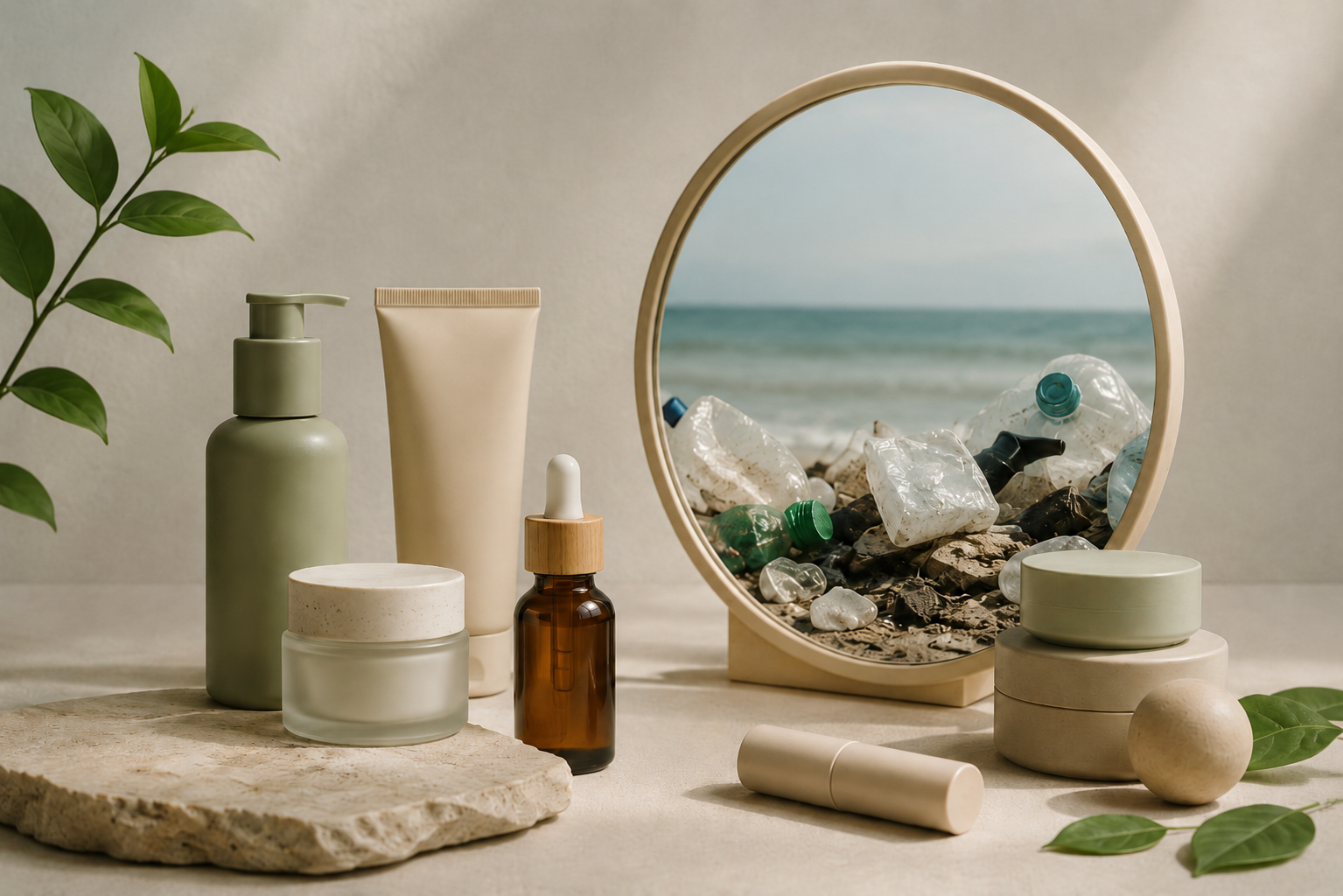
But packaging is also the most visible part of a much larger system. A product can be sold in an attractive refillable bottle and still contain ingredients linked to deforestation, require substantial energy to manufacture, release persistent materials into wastewater or be discarded because the consumer was encouraged to buy more than they could use.
The beauty industry does not simply have a packaging problem. It has a product-lifecycle problem.
Sustainability starts with the ingredients
A cosmetic formulation may contain water, oils, waxes, fragrances, surfactants, preservatives, pigments, polymers and botanical extracts sourced through several layers of suppliers. Each ingredient carries its own environmental and social footprint.
Palm oil and palm-kernel derivatives, for example, are widely used to produce surfactants, emulsifiers and other functional ingredients. The Roundtable on Sustainable Palm Oil estimates that at least 70 per cent of cosmetics contain palm oil or palm-kernel oil derivatives.
The challenge is not necessarily to eliminate palm oil. Replacing a highly productive crop with another vegetable oil may require more agricultural land. The more meaningful questions involve traceability, farming practices, deforestation risk and whether certified material can be followed through a complicated derivatives supply chain.
Minerals present another challenge. Mica gives makeup products their shimmer, but responsible sourcing requires brands to examine labour conditions and supply-chain transparency, not simply confirm that the ingredient is natural. The Responsible Mica Initiative was established specifically to eliminate child labour and unacceptable working conditions across mica supply chains in mining regions including India and Madagascar.
This illustrates one of beauty’s recurring sustainability traps: natural does not automatically mean sustainable.
"A high percentage of natural-origin ingredients is therefore not the same as a low environmental footprint."
A natural ingredient may require intensive farming, extensive land, irrigation or long-distance transportation. A synthetic alternative may use fossil-based feedstocks but require less land and offer greater consistency or stability. Neither category provides a complete answer on its own.
Even ISO 16128, the international standard commonly associated with calculating natural and organic content in cosmetics, explicitly states that it does not address human safety, environmental safety, socio-economic considerations such as fair trade, or the characteristics of packaging materials.
What goes down the drain matters
Many beauty and personal-care products are designed to disappear after use. Cleansers, shampoos, conditioners, scrubs and toothpaste are washed away within minutes. Once rinsed off, their ingredients enter domestic wastewater systems, where their environmental fate depends on biodegradability, concentration and the ability of wastewater-treatment processes to remove them.
Microplastics have become the clearest example of this problem. They have been intentionally added to some personal-care products to provide texture, exfoliation, film formation or other functions. Once rinsed away, these persistent particles can travel through wastewater pathways and enter the wider environment.
The European Union began restricting intentionally added synthetic polymer microparticles on 17 October 2023 under Regulation (EU) 2023/2055. The measure covers cosmetics alongside detergents, glitter and fertilisers, and includes phased transition periods running out to 2035 for categories such as make-up and nail products, giving manufacturers time to reformulate.
Microplastics, however, are only part of the formulation question. A serious sustainability assessment should also consider whether ingredients biodegrade, whether they accumulate in the environment, their potential aquatic effects and what happens when several substances are released together. Removing visible plastic beads from a facial scrub does not necessarily make the entire formulation environmentally benign.
The bathroom is part of the supply chain
A product’s environmental impact does not stop when it leaves the factory. Rinse-off products require water. Many are used during warm showers, meaning their use is also connected to the energy required to heat that water. The European Commission’s Product Environmental Footprint methodology consequently assesses products across raw-material extraction, production, use and end-of-life rather than looking only at factory emissions.
This creates opportunities for better product design. A concentrated shampoo that requires a smaller dose may reduce ingredients, transportation weight and packaging. A formula that rinses away more quickly may help reduce water use. Products that work effectively at lower temperatures can reduce the energy associated with use.
However, these benefits need to be demonstrated rather than assumed. Concentrates may be wasted if consumers use the same quantity as a conventional product. Refill pouches may use less material but still be difficult to recycle. Solid products may reduce water and packaging but require different ingredients, storage conditions or consumer behaviour. Every apparent solution involves trade-offs.
Beauty's business model creates waste too
The industry’s sustainability challenge is also commercial. Beauty companies depend on product launches, seasonal collections, promotional sets, free samples and rapidly changing trends. Retailers need sufficient stock to avoid empty shelves, while brands continually introduce new shades, scents and formulations to generate attention.
This system creates product waste long before an empty container reaches a recycling bin. Testers can expire or become contaminated. Returned cosmetics may be unsuitable for resale. Discontinued lines and unsold seasonal products may remain in warehouses until they are destroyed or discarded. Consumers also accumulate half-used products that expire after the next trend or promotion arrives.
The scale is difficult to establish because companies rarely publish figures for unsold, returned or expired inventory. That lack of data is itself part of the problem: the sector cannot manage product waste effectively if it measures only packaging placed on the market. A recyclable container does little good when the formula inside it was never used.
"Clean, vegan and green" answer different questions
Beauty sustainability is further complicated by the number of claims appearing on products. “Clean beauty” generally concerns selected ingredients that a brand chooses to include or exclude. “Vegan” means that a product does not contain animal-derived ingredients. “Cruelty-free” addresses animal-testing policies. “Natural” describes the origin or processing of ingredients.
These attributes may matter to consumers, but none independently demonstrates that a product has a smaller overall environmental footprint. A vegan formula can still contain persistent synthetic materials. A natural ingredient can be linked to intensive land use. A glass bottle may be recyclable but heavier to transport. A refillable package may produce little benefit when customers rarely purchase the refill.
"Sustainability cannot be reduced to a single logo on the label."
What meaningful progress looks like
Packaging should remain part of the solution, but it must sit within a wider strategy. Beauty companies need to evaluate the complete product: where its ingredients come from, how they are processed, how much energy and water manufacturing requires, what happens during consumer use, and how both the remaining formula and its container are handled at the end.
That means improving ingredient traceability, testing biodegradability and aquatic impacts, reducing manufacturing emissions, designing products that use smaller doses, preventing excess inventory, and publishing clearer lifecycle information. It may also mean launching fewer products.
The most sustainable product is not necessarily the one presented in the greenest-looking container. It may be the product that performs reliably, is used completely, replaces several unnecessary items and remains relevant long enough to avoid being discarded.
Packaging is what consumers see. The formulation, supply chain, usage pattern and business model are largely hidden. That is precisely why the beauty industry’s sustainability conversation must go deeper than the bottle.