Artificial intelligence is rapidly becoming part of modern healthcare, from diagnostic imaging and patient monitoring to clinical decision support systems and workflow optimisation. Yet while healthcare AI capabilities are advancing quickly, regulation has often struggled to keep pace.
Singapore’s latest move may offer a glimpse into how healthcare regulation itself is beginning to evolve.
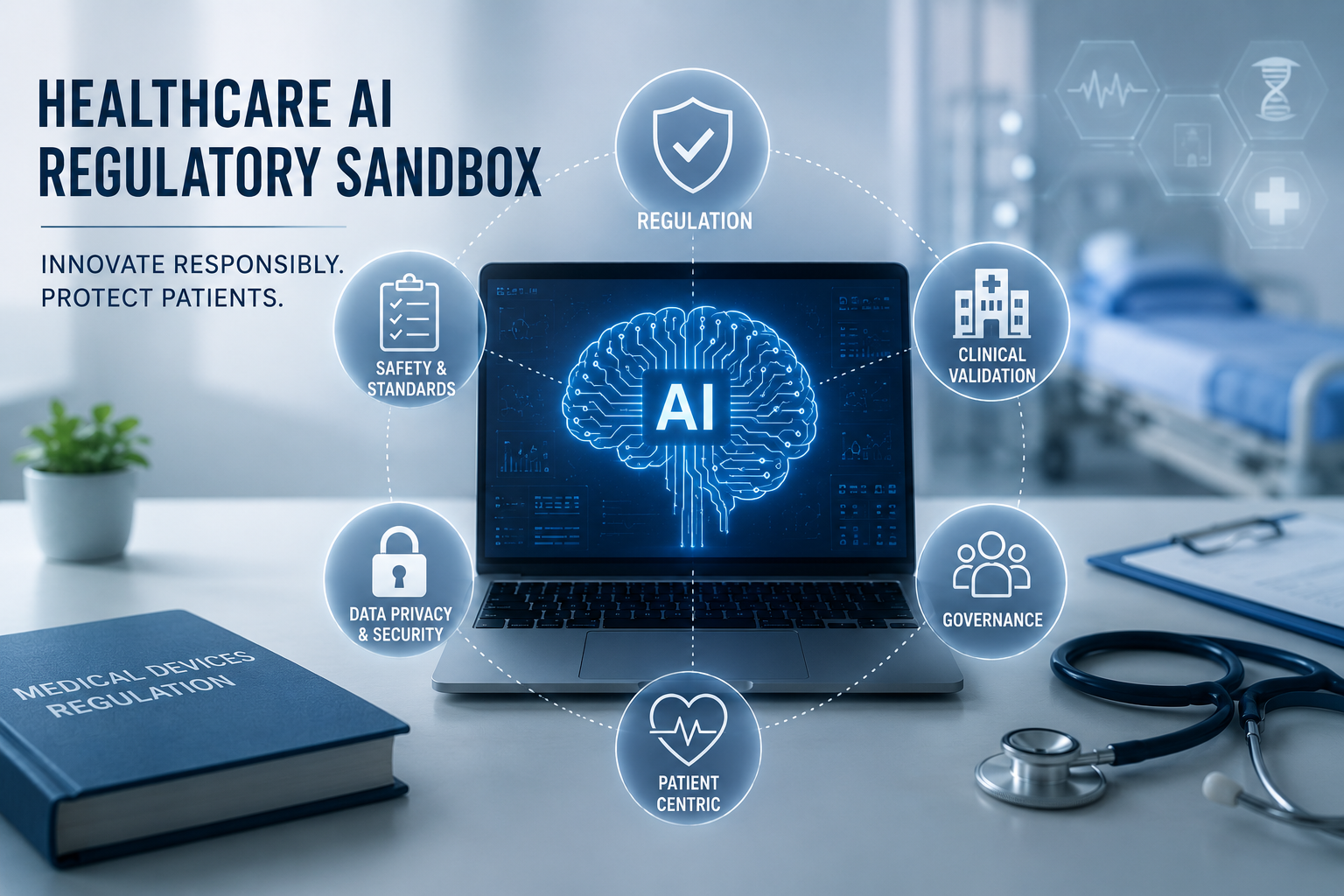
In February 2026, Singapore’s Health Sciences Authority (HSA) published its response to feedback on a proposed regulatory sandbox involving Artificial Intelligence Software as a Medical Device (AI-SaMD). The initiative would allow selected public healthcare entities to develop and use certain healthcare AI systems without undergoing the usual manufacturer licensing and product registration requirements, provided safeguards and oversight measures are implemented.
At first glance, the move may appear administrative or procedural. In reality, it reflects something far more significant.
Singapore is not simply tightening control over healthcare AI. It is attempting to create a structured pathway for healthcare AI innovation to happen safely within regulated environments.
Why traditional medical device regulation is being challenged
Conventional medical device regulation was largely built around relatively stable products.
A device is developed, tested, reviewed, approved, and then deployed into the market with only incremental updates over time. Artificial intelligence systems, however, behave differently.
AI-powered medical software may continue evolving after deployment. Models may be retrained. Performance can shift depending on data quality, patient demographics, or operational environments. Some systems may improve continuously as they encounter new datasets and clinical scenarios.
This creates a regulatory challenge.
How do regulators maintain patient safety while still allowing healthcare AI innovation to move at a practical pace?
Globally, regulators are still trying to answer this question.
Singapore’s sandbox approach suggests that future healthcare regulation may become less about static approval and more about controlled experimentation, monitored deployment, and continuous oversight.
Using a sandbox approach
Regulatory sandboxes are already familiar in industries such as fintech, where they allow companies to test innovative solutions under controlled regulatory supervision before full-scale deployment.
Applying a similar model to healthcare AI is significant because healthcare environments are far more sensitive and complex.
Under Singapore’s proposed framework, selected public healthcare institutions may be able to develop and deploy specific AI-powered medical software within defined boundaries and safeguards without immediately entering the full commercial regulatory pathway.
This could help reduce friction for:
- Early-stage healthcare AI pilots
- Clinical validation studies
- Proof-of-concept deployments
- Collaboration between hospitals, researchers, and startups
- Real-world testing of AI systems under supervision
For many healthcare AI companies, obtaining meaningful clinical validation remains one of the most difficult barriers to growth. Access to hospitals, clinicians, operational workflows, and high-quality healthcare data is often limited and heavily regulated.
A sandbox environment potentially creates a bridge between innovation and real-world healthcare deployment.
A healthcare AI validation bub
The broader strategic implication is difficult to ignore.
Increasingly, countries are competing not only for healthcare investments, but also for leadership in healthcare innovation ecosystems. In the AI era, one important competitive advantage may be the ability to provide trusted regulatory environments where emerging technologies can be safely tested and refined.
Singapore already possesses several advantages:
- Strong public healthcare infrastructure
- Established biomedical and MedTech sectors
- Regulatory credibility
- Advanced research institutions
- Government support for deep-tech innovation
- Strong regional connectivity within Asia
The regulatory sandbox could strengthen Singapore’s position as a destination for healthcare AI development, early-stage validation, and translational healthcare innovation.
This may attract:
- AI diagnostic startups
- MedTech firms
- Healthcare software companies
- Research collaborations
- Clinical AI pilot programmes
- International healthcare technology partnerships
Rather than functioning solely as a market for healthcare AI products, Singapore could increasingly become a trusted testing ground for them.
Trust may become the real competitive advantage
One overlooked reality of healthcare AI is that technical performance alone is rarely sufficient.
Healthcare systems operate on trust.
Clinicians need confidence that systems are safe and reliable. Hospitals require governance frameworks. Regulators need oversight mechanisms. Patients need assurance that technologies are being deployed responsibly.
As AI becomes more deeply integrated into healthcare operations, regulatory credibility may become just as important as technological capability.
Countries that can successfully balance innovation with trust may gain disproportionate influence in shaping the future healthcare ecosystem.
Singapore’s regulatory sandbox signals that the country understands this balance.
A signal of where healthcare regulation is heading
Perhaps the most important takeaway is that healthcare regulation itself is evolving.
Regulators are no longer only asking whether a medical technology is safe at launch. Increasingly, they are exploring how innovation can happen safely within controlled environments while technologies continue evolving over time.
This represents a broader shift:
from static approval toward adaptive oversight.
For healthcare AI companies, MedTech firms, investors, and healthcare institutions, this may become one of the defining regulatory themes of the next decade.
And in 2026, Singapore appears determined to play an active role in shaping that future.
References
Accessed on 8 May 2026.
- Singapore Health Sciences Authority (HSA) — Response to feedback on proposed exemption framework for AI Software as a Medical Device (AI-SaMD)
HSA Announcement - Singapore Health Sciences Authority (HSA) — AI-enabled Medical Device Risk Classification Tool announcement
HSA AI Risk Classification Tool