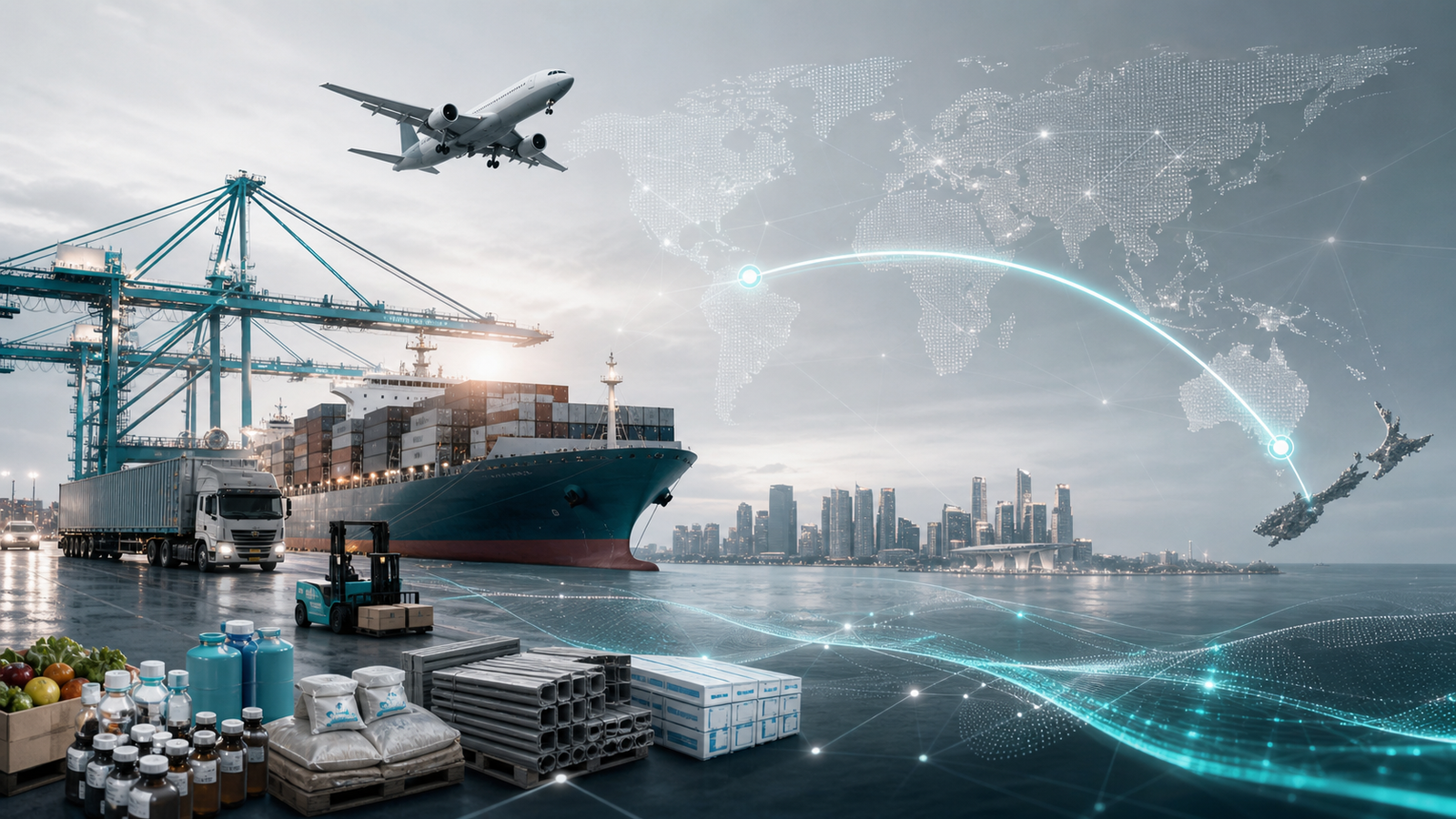
For many years, supply chain strategy was often discussed in terms of cost, speed, and efficiency. Businesses wanted cheaper sourcing, faster delivery, leaner inventory, and wider access to suppliers. But the past few years have changed the conversation. Pandemics, wars, port disruptions, energy shocks, export controls, climate events, and geopolitical tensions have reminded companies of one uncomfortable truth: a low-cost supply chain is not always a reliable one. On 4 May 2026, Singapore and New Zealand signed the Agreement on Trade in Essential Supplies, described by Singapore’s Ministry of Foreign Affairs as the world’s first legally binding bilateral supply chain resilience agreement. The agreement commits both countries to facilitate trade flows even during supply chain disruptions, and not to impose unnecessary export restrictions on agreed essential supplies such as food, fuel, healthcare, chemical, and construction products. This may sound like a government-to-government trade agreement. But for manufacturers, food producers, healthcare suppliers, logistics companies, and SMEs, the message is much wider. The future of competition is not only about who can produce the cheapest product. It is also about who can be trusted to deliver when conditions become difficult.
From efficiency to resilience
For decades, many companies optimised supply chains around efficiency. Lean operations, just-in-time delivery, low inventory, and global sourcing allowed businesses to reduce costs and improve margins. That model still matters. No business can ignore cost.
But efficiency without resilience can become fragile. When borders close, shipping lanes are disrupted, energy prices move sharply, or governments restrict exports, companies suddenly discover that the lowest-cost option may not be the safest option.
The Singapore-New Zealand agreement reflects this shift. Beyond the commitment not to impose unnecessary export restrictions, the pact also creates a framework for both countries to facilitate the movement of goods, share information, and consult each other before or during supply chain disruptions. The agreement will enter into force after both sides complete their domestic procedures, and it will be incorporated into the existing New Zealand-Singapore bilateral free trade agreement.
For businesses, this points to a larger principle: resilience is no longer just an operational issue. It is a trust issue.
Customers want to know whether suppliers can continue delivering during disruption. Governments want reliable access to critical goods. Large companies want partners who can support their continuity plans. Investors and buyers want to see whether a company is prepared for uncertainty. In other words, resilience is becoming part of reputation.
Trusted partners matter more in uncertain times
At the joint press conference, Prime Minister Lawrence Wong said the agreement sends a signal that “even under strain, trusted partners will keep faith with one another.” He added that in times of crisis or shortages, the two countries would keep essential goods flowing, rather than shutting each other out.
That line is important for businesses.
When conditions are stable, companies may be judged mainly by price, product quality, or delivery speed. But when conditions become unstable, buyers start asking different questions.
Can this supplier still deliver?
Does this partner have alternative routes?
Will this company communicate early if there is a disruption?
Can it provide visibility into its supply chain?
Does it have relationships that can hold under pressure?
For SMEs, these questions matter because trust is often the deciding factor in B2B relationships. A manufacturer may not be the largest player in the market, but it can still win if customers believe it is reliable, transparent, and prepared.
This is especially relevant for Singapore-based SMEs. Singapore is a small, open economy that depends heavily on trade, imports, logistics connectivity, and regional relationships. A Singapore company that wants to grow regionally cannot rely only on product brochures or pricing sheets. It must also communicate operational confidence.
That means supply chain resilience should become part of how SMEs present themselves.
Reliability can be part of the value proposition
Many SMEs still describe themselves using familiar phrases: “high quality”, “customer-focused”, “reliable”, “one-stop solution”, or “trusted partner”. The problem is that these phrases are often generic.
The new business environment requires companies to make reliability more concrete.
For a manufacturer, reliability may mean having diversified suppliers, clear lead-time planning, documented production capacity, and a system for communicating delays early.
For a food producer, it may mean ingredient traceability, cold-chain discipline, packaging alternatives, and contingency sourcing.
For a healthcare or medtech supplier, it may mean regulatory documentation, inventory planning, quality assurance, and the ability to support critical demand during shortages.
For a logistics company, it may mean route visibility, alternative transport options, and proactive customer updates.
For a B2B service provider, it may mean continuity planning, knowledge documentation, and the ability to support clients even when teams are stretched.
These are not just back-end operational details. They can become part of a company’s brand.
A company that can explain how it manages risk gives buyers more confidence. A company that can show documentation, systems, and contingency plans looks more mature. A company that communicates clearly during disruption earns trust that cannot be created by advertising alone.
Supply chain trust will shape market expansion
The Singapore-New Zealand pact also carries a market expansion lesson.
New Zealand Prime Minister Christopher Luxon noted that around a third of New Zealand’s fuel is refined in Singapore, while New Zealand is also a trusted supplier of food and other essential goods to Singapore. He said the agreement turns longstanding trust into practical action by keeping essential trade flowing in a crisis.
This is exactly how SMEs should think about overseas expansion.
Entering a new market is not only about finding buyers. It is about becoming a partner that buyers can rely on.
When a company enters another country, it carries a trust deficit. New customers may not know its track record. Distributors may not know whether it can support them. Buyers may not know whether it can deliver consistently. Government agencies, large corporates, and procurement teams may need more proof before they take a risk.
That is why SMEs preparing for market expansion should strengthen their trust assets before they go overseas.
These trust assets include a clear company profile, proper case studies, relevant certifications, documented processes, strong website communication, credible leadership visibility, customer testimonials, and evidence of operational reliability.
A trade mission may open doors. But trust keeps the door open.
SMEs should not wait for disruption before preparing
The worst time to build a resilience plan is during a crisis.
By then, suppliers may already be unavailable, customers may already be anxious, and competitors may already be offering alternatives. Companies that prepare early are in a stronger position because they can respond with clarity rather than panic.
SMEs can start with a simple supply chain resilience review.
Which materials, products, or services are critical to the business?
Which suppliers are difficult to replace?
Which customers would be most affected by delays?
Which documents are needed when customers ask about continuity?
Which messages should be prepared if disruption happens?
Which alternative partners or routes should be explored now?
This does not require a large corporate risk department. It requires discipline, documentation, and leadership attention.
For many SMEs, the first step may simply be making invisible dependencies visible.
The new competitive advantage
The Singapore-New Zealand agreement may be a bilateral pact between two countries, but it reflects a much bigger business reality.
The world is becoming more uncertain, not less. Companies will continue to face shocks they cannot fully control. What they can control is how prepared, transparent, and trustworthy they are when those shocks happen.
For manufacturers and SMEs, the next competitive advantage may not come only from lower cost, better design, or faster production. It may come from being the company that customers trust when conditions are difficult.
Supply chains used to sit quietly behind the business.
Now, they are becoming part of the business story.
And in that story, trust may become the most valuable product a company can deliver.